


News
- ▶ Qingdao Shinuode Showcases Next-Generation Portable Power & Air Compressor Solutions at Global Sources Consumer Electronics Show 2026
- ▶ Is it safe to store a cordless SUV tire pump in a hot vehicle?
- ▶ When a portable air pump cannot make a punctured SUV tire safe to drive
- ▶ How accurate is the auto shutoff on a portable air pump for SUV tires?
- ▶ Using a portable air pump to reinflate SUV tires after off-roading
Message
Air Pump Inflator vs Compressor: Which Fits Light-Duty Service Work?
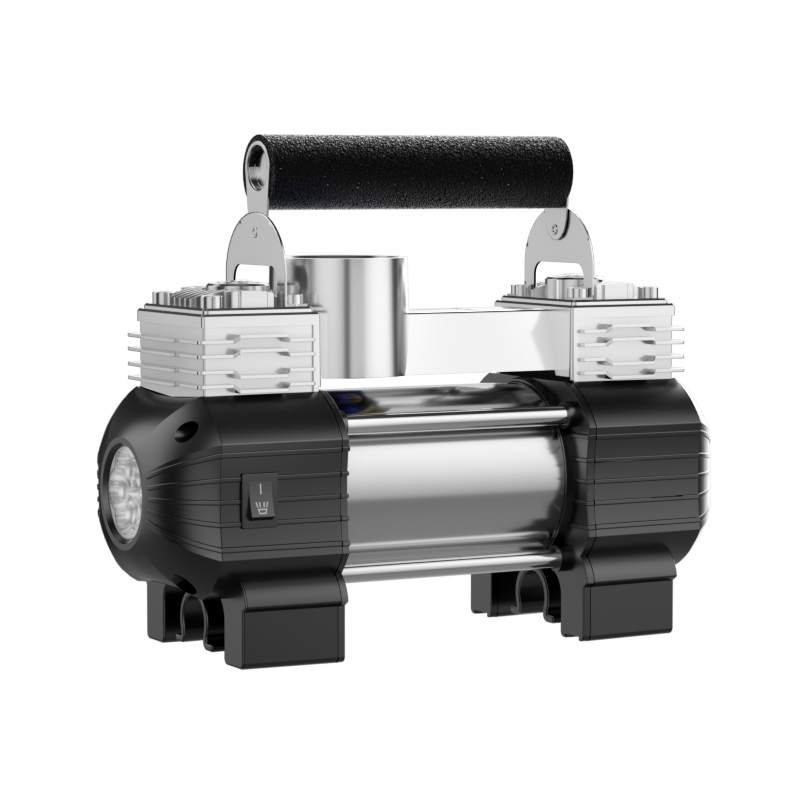
For light-duty service work, an Air Pump Inflator is usually the better fit when the job centers on topping up tires, inflating small pneumatic items, or handling short intermittent pressure tasks at the vehicle side. A compressor becomes the stronger option when the work includes repeated inflation cycles, higher air volume demand, or occasional use of air tools. The selection should start with the actual load profile rather than the maximum pressure printed on the housing.
An Air Pump Inflator is generally built around compact electric motor assemblies, small piston or diaphragm pumping units, lightweight housings, and direct power input from a vehicle socket, battery pack, or AC adapter. In manufacturing terms, this product category favors reduced mass, simplified assembly, and easier transport. For service use, that translates into low storage burden and fast setup. A compressor, even in a portable version, usually carries a larger motor, heavier cylinder block, more robust thermal management, and in many cases an air tank or higher-flow pump head. Those structural differences matter more than naming conventions, because two products may both be sold as “portable inflators” while their service capacity is very different.
Pressure rating does not describe the whole job
A common evaluation mistake is to compare only peak pressure. Light-duty service work often depends more on airflow stability and fill time than on the final pressure ceiling. A compact Air Pump Inflator may advertise enough pressure for passenger car tires, bicycle tires, and motorcycle tires, yet still feel slow when filling larger-volume tires because its displacement per cycle is limited. A compressor with a lower advertised peak pressure can still complete the same job faster if its volumetric output is higher.
This distinction becomes important in workshops, roadside kits, maintenance carts, and field service vans where time between tasks matters. If the equipment will mainly restore a tire from a small pressure drop, a compact inflator is usually acceptable. If it may need to raise a light truck tire from a much lower state, repeated long run time can expose the weaknesses of a small pump head, especially in units with narrow heat dissipation paths or plastic-heavy internal supports.
Duty cycle and thermal behavior often decide service suitability
For practical selection, duty cycle deserves more attention than promotional labels. Small inflators can overheat when asked to run continuously. In many light-duty situations, the issue is not whether the unit can reach target pressure once, but whether it can do so several times in succession without long cooling intervals. That is where compressors often justify their added size and weight. Their motor windings, cylinder materials, seals, and cooling design are usually better prepared for repetitive service.
Material choice influences this directly. Aluminum cylinder components can improve heat transfer while keeping mass under control. Steel parts may improve wear resistance in stressed areas but add weight. Polymer housings can be suitable for external shells, yet the internal load-bearing and sealing arrangement determines whether vibration and heat will shorten service life. For a light-duty Air Pump Inflator used occasionally, these tradeoffs may be acceptable. For equipment expected to stay in a service vehicle through hot weather, frequent starts, and uneven power input, thermal margin should be treated as an operating requirement rather than a secondary feature.
Noise and vibration also follow the same pattern. Small high-speed inflators often generate sharper acoustic output because the motor works harder to compensate for limited displacement. A compressor may be louder overall, but some designs produce a steadier operating character that is easier to manage in repeated use. This matters where service work happens in enclosed garages, parking structures, or near customers.
Power source and wiring constraints shape real-world performance
Light-duty service tools are often limited by the available power source. An Air Pump Inflator connected to a vehicle accessory socket may face current restrictions, voltage drop through long cables, and reduced output when the vehicle electrical condition is unstable. Battery-powered versions remove some wiring inconvenience, but runtime, recharge scheduling, and battery aging enter the evaluation. Portable compressors with clamp-style battery connection or AC supply can sustain higher draw, but that also means heavier cables, stricter handling requirements, and less convenience for quick inflation work.
In service environments, cable length and connector robustness are not minor details. Thin conductors can heat up under load, and weak clips or molded plugs may fail before the pump mechanism does. Installation and storage also become relevant. A compact inflator fits more easily into a molded case or vehicle compartment, while a compressor may require dedicated mounting space, especially if vibration isolation pads or hose management are needed.
Application fit depends on the type of “light-duty” work
The term light-duty is broad enough to cause bad selections. If the task set is mostly passenger vehicles, temporary tire pressure correction, bicycles, inflatables, and emergency backup use, an Air Pump Inflator usually aligns well with the service pattern. It starts quickly, stores easily, and avoids the bulk of larger air systems.
If the work can expand into small fleet maintenance, multi-vehicle sequential service, utility trailers, or inflation of larger tires with noticeable air loss, a compressor is usually more stable in operation. It may also be the safer choice where the same unit could later be expected to support blow-off nozzles, pneumatic cleaning, or occasional low-demand air tools. Those jobs can push a compact inflator beyond its intended thermal and mechanical limits.
- A small inflator fits short, irregular inflation events with low storage tolerance and frequent transport.
- Portable compressors make more sense where the same shift may involve repeated tire service and longer continuous run time.
- When the service environment is power-constrained, the simpler inflator may avoid overload issues, but only if the fill volume stays modest.
Another frequent misjudgment is assuming portability always improves usability. In some field setups, a slightly heavier compressor with a stable base, longer hose, clearer gauge, and better thermal reserve may save time overall. In other situations, especially where the tool must be carried by hand across large sites or kept inside emergency vehicle compartments, every extra kilogram reduces practicality.
Maintenance and replacement considerations
Neither category is maintenance-free in strict terms. Hoses, fittings, seals, pressure gauges, switches, and power leads remain wear points. On compact inflators, hose fatigue near the pump outlet is a common concern because repeated bending occurs in a short radius. Compressors can introduce additional service points such as tank drainage, more complex regulators, or vibration-related fastener loosening, depending on configuration.
For long-term use, serviceability should be reviewed at the component level. A unit with replaceable hose assemblies, standard connectors, and accessible fuses is usually easier to keep in rotation than a sealed low-cost unit. In some production and repair ecosystems, related electromechanical parts such as Electronic injection components are evaluated with the same discipline: the visible product outline matters less than the consistency of internal parts, assembly control, and replacement practicality. That same thinking applies here when comparing an Air Pump Inflator with a compressor.
Transport, packaging, and storage are part of the selection
In manufacturing and distribution, the form factor affects more than shelf appearance. Compact inflators are easier to carton, palletize, and store in dense quantities. Their lower mass may reduce handling strain and simplify inclusion in emergency kits. Compressors need more protective packaging because of heavier internal assemblies and higher risk of transit damage if the pump head, gauge, or tank mount receives impact. If the product will spend long periods in vehicle storage, dust resistance, casing rigidity, and hose retention design become practical selection points.
Environmental conditions should also be considered. Cold weather can stiffen hoses and affect seal behavior. High ambient temperature can shorten allowable continuous run time. Moisture exposure can influence motor durability, switch life, and connector reliability. A light-duty designation does not remove these operating limits; it only means the machine is not intended for sustained industrial air demand.
Where compactness is the main priority and the service pattern remains short-cycle, an Air Pump Inflator is usually the cleaner choice. Where the workload is still called light-duty but includes repetition, larger tire volume, or some future task expansion, a compressor often provides a wider operating margin with fewer interruptions.
Please give us a message