


News
- ▶ Preventing Blown Fuses When Using a 12V Portable Air Pump on Vehicles
- ▶ 12V Portable Air Pump Duty Cycle: What It Means for Field Reliability
- ▶ How to Size a 12V Portable Air Pump for Fleet Tire Service Requirements
- ▶ Does battery runtime limit Emergency Tire Inflator reliability?
- ▶ Is an Air Pump Inflator practical for high-volume retail sales?
Message
Can a Portable Tire Inflator Support Small Fleet Maintenance Efficiently?

Where a Portable Tire Inflator Actually Earns Its Place
The real test is not whether a Portable Tire Inflator can add air. It is whether it can keep a small fleet moving without forcing maintenance staff to pull vehicles out of service for minor pressure loss. In plant logistics, regional service fleets, and mixed-use company vehicles, that distinction matters. A van delayed by one underinflated tire may miss a site call; a forklift support pickup running late can disrupt an internal material flow; a field technician may spend more time finding a compressor than fixing the actual issue.
For small fleets, tire pressure problems are often operationally small but financially annoying. They rarely justify a workshop slot by themselves, yet they quietly create fuel waste, uneven tire wear, and driver complaints. That is where portable inflation equipment tends to make sense: not as a replacement for structured maintenance, but as a fast-response tool between scheduled checks.
Why Small Fleets Use It Differently from Large Transport Operations
Large transport fleets usually have fixed service routines, bay equipment, and clearer tire management protocols. Small fleets are less standardized. A manufacturer may operate a few delivery vans, supervisor cars, emergency support vehicles, and one or two utility trucks. They are parked in different places, used by different teams, and checked with uneven discipline. In that environment, centralized air supply is not always where the vehicle is.
A portable unit becomes efficient when the maintenance problem is distributed: multiple vehicles, light-to-medium duty cycles, limited workshop access, and a need to correct pressure on the spot. It is less convincing when the fleet is heavy-duty, tire volumes are large, or inflation must be done continuously across many vehicles in one shift. Then speed, thermal stability, duty cycle, and airflow capacity start to matter more than portability.
That is often where buyers misjudge the category. They ask whether a compact inflator can support fleet maintenance, when the better question is: which part of fleet maintenance should it cover? Daily readiness checks? Emergency top-ups? Seasonal pressure adjustment? Or workshop-level recovery after repeated low-pressure events? The answer changes the tool selection completely.
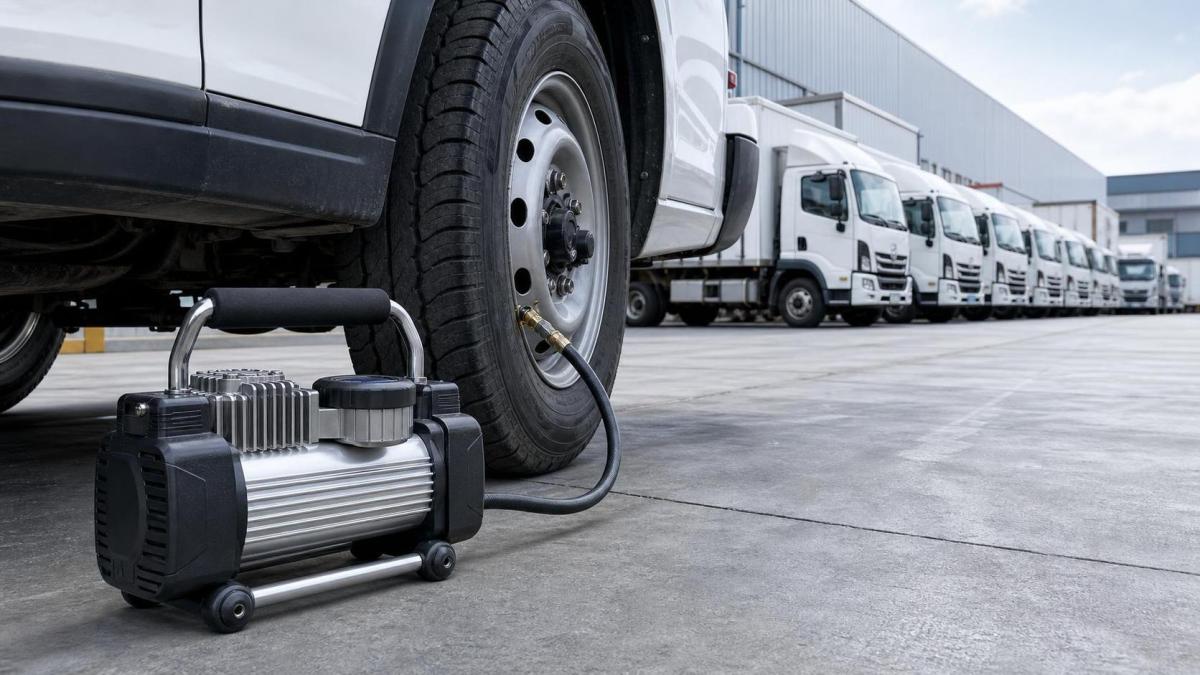
The Site Conditions That Decide Efficiency
On factory grounds, efficiency is rarely about inflation speed alone. Access, cable reach, storage discipline, and operator behavior usually decide whether the tool gets used properly. If vehicles are parked outdoors at scattered loading points, a portable inflator saves walking time and avoids moving a vehicle with visibly low pressure to a distant air station. If vehicles are garaged beside a fixed compressor, the portable option may only be a backup.
Power source also changes the picture. A rechargeable model may suit mobile maintenance staff who inspect vehicles away from the shop. A 12V model fits vehicles that need occasional roadside correction. Neither is automatically better. Rechargeable units depend on charge management; vehicle-powered units depend on cable length, connector durability, and whether the operator can safely stay parked during use.
Dust, rain exposure, and rough handling should not be treated as minor details. In manufacturing and processing environments, tools are often stored in service carts, pickup compartments, or shared cabinets. An inflator that performs well on a spec sheet but cannot tolerate repeated transport, hose strain, and inconsistent storage will become a nuisance item rather than a maintenance asset.
What It Can Realistically Improve
Used well, a Portable Tire Inflator improves control at the margins, and those margins matter. Drivers can report pressure loss earlier because correction is easy. Maintenance teams can verify and top up before dispatch instead of deferring the issue. Vehicles with slow leaks can be managed temporarily while waiting for proper tire service, provided the leak is understood and the vehicle remains safe to operate.
This is especially practical for operations that cannot afford avoidable dead time but do not run enough vehicles to justify a dedicated tire service setup. The benefit is not dramatic in one event. It accumulates through fewer minor delays, fewer unnecessary workshop movements, and better discipline around pre-trip inspection.
In some equipment supply chains, even supporting parts from adjacent manufacturing categories reflect the same logic of control and consistency. Companies that manage in-house development and production, including items such as Electronic injection components for injection molded products, usually understand that reliability in the field starts long before final assembly. That matters when fleet tools are being sourced for repeat orders or private-label programs, not just one-off purchases.
Where It Stops Being the Right Tool
There are clear limits. If the fleet includes larger commercial vehicles with high-volume tires, the inflator may still be useful for emergency stabilization, but not as the main maintenance method. If pressure losses are frequent across several vehicles, the issue is probably not inflation access. It may be tire condition, valve leakage, loading practice, or poor inspection routines. Adding a portable unit to that situation can hide the symptom without solving the maintenance problem.
Another weak fit is unmanaged shared use. One portable device for many drivers sounds efficient until no one knows who charged it, who returned it, or whether the gauge remains accurate. Small fleets often succeed with portable inflators only when someone owns the process: fleet supervisor, workshop lead, or dispatch-controlled vehicle check.
Questions Worth Asking Before Selection
These questions sound basic, but they usually expose whether the purchase is being driven by a real operating gap or by a general assumption that every fleet should carry an inflator.
Manufacturing Perspective: Why Supply Structure Matters
For buyers sourcing under their own brand or for recurring fleet kits, manufacturing depth matters more than many expect. Qingdao Shinuode Intelligent Technology Co., Ltd. brings more than 10 years of experience in intelligent auto emergency tools, with a 12,000 square meter factory, professional staff, and in-house coverage from R&D to mold development and mass production. That kind of integrated chain does not automatically guarantee the perfect product for every fleet, but it does matter when consistency, delivery control, and customization are part of the purchasing decision.
This becomes relevant when the inflator is not a one-time retail item but part of a broader equipment program: domestic bulk supply, cross-border dropshipping, vehicle emergency kits, or tailored packaging for different service channels. In those cases, the hidden efficiency is often upstream. Stable quality and fewer sourcing variables reduce the operational noise that maintenance teams end up dealing with later.
So, can a Portable Tire Inflator support small fleet maintenance efficiently? Usually yes, when the job is distributed, response time matters, and the fleet sits in the light-vehicle to light-commercial range. It is less about replacing workshop infrastructure and more about closing the gap between inspection and action. Before selecting one, map the actual pressure-loss events, parking layout, user habits, and vehicle types. That will tell you whether you need a convenient tool, a tougher service device, or a better tire management routine altogether.
Please give us a message