


News
- ▶ Qingdao Shinuode Showcases Next-Generation Portable Power & Air Compressor Solutions at Global Sources Consumer Electronics Show 2026
- ▶ Is it safe to store a cordless SUV tire pump in a hot vehicle?
- ▶ When a portable air pump cannot make a punctured SUV tire safe to drive
- ▶ How accurate is the auto shutoff on a portable air pump for SUV tires?
- ▶ Using a portable air pump to reinflate SUV tires after off-roading
Message
Choosing Compact Portable Car Tire Solutions for Rental Cars and Shared Mobility
Choosing Compact Portable Car Tire Solutions for Rental Cars and Shared Mobility
For rental fleets and shared mobility operators, tire trouble is rarely just a roadside inconvenience. A slow leak, underinflated tire, or minor puncture can turn into a missed booking, an unhappy user, a vehicle relocation task, and extra labor for field teams. That is why choosing a Compact Portable Car Tire solution deserves more attention than it often gets. The right tool is not simply “small and easy to store.” It has to fit the realities of high-turnover vehicles, mixed driver skill levels, and tight operating cost control.
In practice, project managers usually need a balance: compact enough for passenger cars and urban vehicles, strong enough for repeated use, simple enough for non-technical users, and consistent enough for large-scale procurement. If one of those conditions is missed, the tool may look fine in a catalog but perform poorly once it is deployed across dozens or hundreds of vehicles.
What matters in real fleet use
A shared mobility environment is different from private car ownership. Tools are handled by many people, stored in limited trunk space, and exposed to irregular maintenance cycles. That changes the evaluation standard.
The first concern is response speed. When a vehicle is stuck due to low tire pressure, the question is not whether inflation is possible, but how quickly the unit can return the vehicle to service. A compact inflator with unstable output or an inaccurate gauge may create more service calls instead of reducing them.
The second concern is usability. In rental and car-sharing scenarios, some tools are intended for trained service staff, while others may be used by end drivers under remote guidance. That distinction matters. If controls are confusing, pressure readings are hard to read, or hose handling is awkward, the failure rate goes up even when the hardware itself is technically adequate.
Then there is portability. Compact Portable Car Tire equipment should not occupy too much cargo space, especially in small sedans, hatchbacks, or EV fleets where storage volume is already limited. But “compact” should not come at the cost of durability. Lightweight construction is useful only if the product still tolerates vibration, frequent transport, and repeated duty cycles.
The specifications worth checking before procurement
For project evaluation, a few parameters are more meaningful than broad marketing language.
Power source compatibility is one of them. Many fleet operators still rely on 12V DC vehicle-side use, but in workshop or depot settings, broader input options can improve flexibility. Size also matters in a measurable way. A unit around 24 × 12 × 21 cm may still be portable enough for storage while offering more substantial pumping capacity than ultra-mini consumer models.
Output and load capacity should be reviewed in the context of your vehicle mix. A heavy-duty dual-cylinder design, for example, may be more suitable for operators handling not only passenger cars but also support vehicles, vans, or outdoor service units. Rated power, peak power, and current draw are not abstract numbers; they help determine whether the tool can deliver stable inflation performance without creating compatibility issues in field use.
Functions beyond inflation can also be worth paying for, but only if they solve a real operational problem. Pressure gauge accuracy is useful because under- or over-inflation creates safety and tire wear issues. LED lighting helps in night roadside work. Deflation capability can matter in some off-road or specialty applications, though it may be less critical for urban car-sharing fleets.
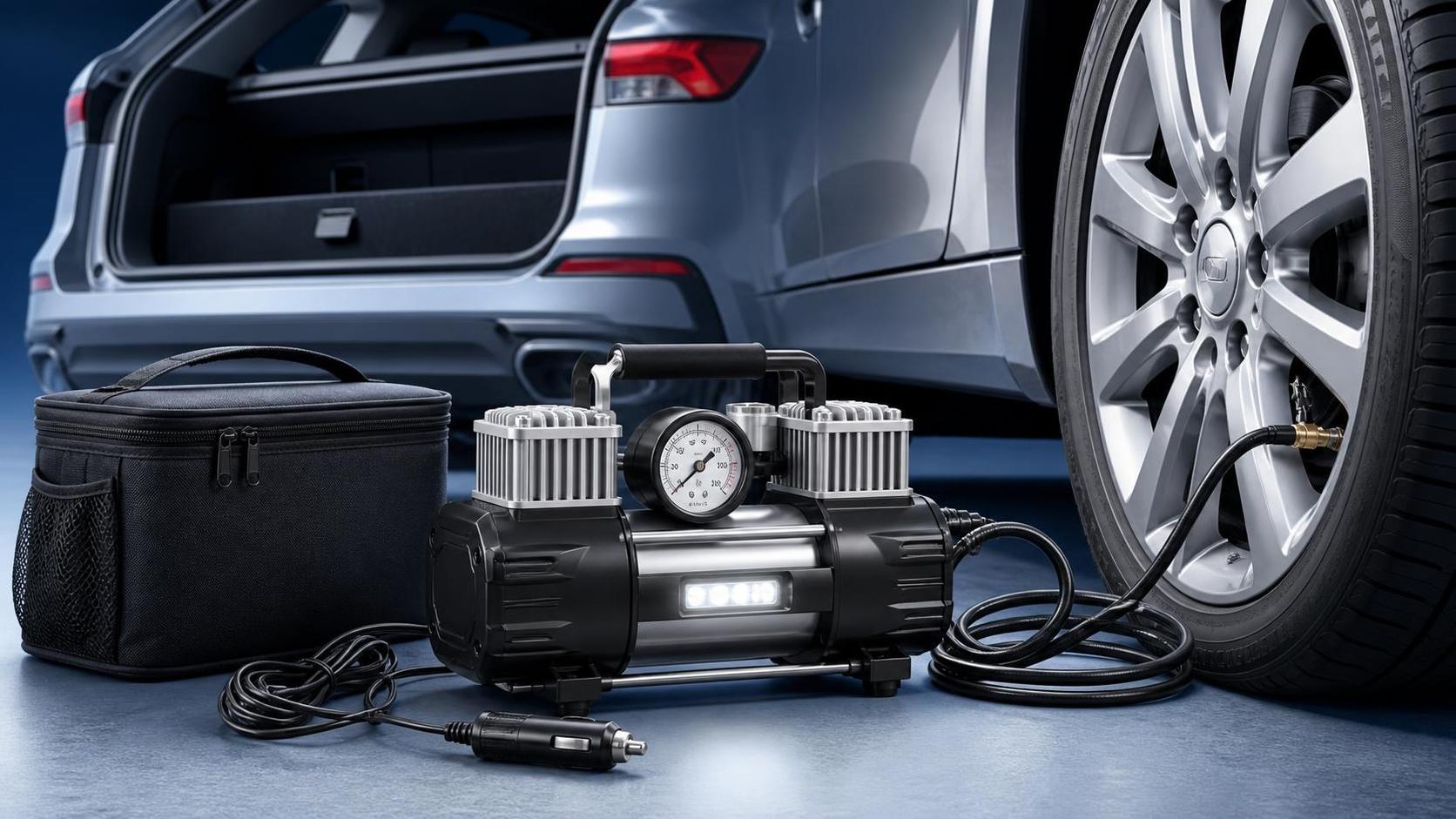
One example of a more robust portable option in this category is Wholesale New Intelligent Heavy Duty Dual Cylinder Air Pump Precise Pressure Gauge LED Light For Truck RV Offroad MP-08GR. Its published parameters include 12V DC operation, 180W rated power, 350W peak power, 15A working current, and integrated functions such as inflation, air refill, deflation, LED lighting, and pressure display. For a fleet manager, those details are more useful than generic claims about convenience.
Common selection mistakes
A frequent mistake is buying for the lightest use case instead of the actual operating environment. If the fleet includes SUVs, service vehicles, or cars that see continuous daily use, a very small inflator designed mainly for occasional consumer emergencies may not hold up well over time.
Another mistake is treating all pressure gauges as equal. In field maintenance, poor readability or inconsistent measurement can create repeated inflation adjustments and user uncertainty. The result is wasted labor and, sometimes, avoidable tire wear.
There is also the sourcing problem. Some buyers focus on unit price and overlook supply consistency. For project-based procurement, especially across multiple SKUs or custom packaging requirements, stable production control often matters more than shaving a small amount off the first order. If a supplier depends heavily on outsourced processes, lead time and quality variation can become harder to manage.
Why manufacturing depth affects project outcomes
This is where the manufacturing side becomes relevant, even for buyers focused mainly on operations. Qingdao Shinuode Intelligent Technology Co., Ltd. has more than 10 years of manufacturing experience in intelligent auto emergency tools and operates a 12,000㎡ factory with in-house staff and production equipment. More importantly, its industrial chain covers R&D, mold development, and mass production without outsourcing.
That kind of structure usually helps with three practical concerns: product consistency, delivery control, and customization cost. For project managers, those are not background details. They affect whether the same Compact Portable Car Tire solution can be rolled out across batches without unexpected variation, whether shipment schedules can match seasonal fleet expansion, and whether branding or packaging adjustments remain realistic instead of becoming a sourcing headache.
It also matters if your procurement model is mixed. Some businesses need bulk domestic supply for service centers, while others combine centralized stock with cross-border dropshipping for regional partners. A manufacturer that already supports both models can reduce coordination friction, although the exact fit still depends on your volume, service network, and destination market requirements.
How to match the tool to the operation
The best choice usually starts with a simple internal check. Who will use the tool most often: depot technicians, mobile response teams, or end drivers? How much storage space is available in the vehicle? Is the fleet limited to compact cars, or does it include heavier platforms? Do you need a basic emergency inflator, or a more capable unit that can support broader roadside tasks?
If your use case is mainly urban rental cars, the priority may be intuitive operation, clear pressure reading, and manageable size. If the fleet includes support vans, off-road service vehicles, or locations with more demanding conditions, a heavier-duty portable unit may make better long-term sense even if it is not the smallest option available. In that context, a model family such as MP-08GR, MP-08GO, MP-519GR, or MP-519SI can be evaluated based on power, portability, and duty expectations rather than appearance alone.
A practical procurement review should also confirm local compliance expectations, connector compatibility, packaging needs, and whether spare parts or after-sales support are necessary for your deployment plan. Those points usually require project-specific confirmation rather than assumption.
In the end, choosing a Compact Portable Car Tire solution is less about finding the smallest device and more about selecting a tool that works reliably inside your operating model. If it shortens roadside handling time, fits vehicle constraints, gives consistent pressure control, and comes from a supplier with stable manufacturing capability, it is already doing the job it was bought for. Before moving forward, it is worth checking the real-use scenario, power requirements, and supply arrangement in one discussion instead of treating them as separate decisions.
Please give us a message