


News
- ▶ Qingdao Shinuode Showcases Next-Generation Portable Power & Air Compressor Solutions at Global Sources Consumer Electronics Show 2026
- ▶ Is it safe to store a cordless SUV tire pump in a hot vehicle?
- ▶ When a portable air pump cannot make a punctured SUV tire safe to drive
- ▶ How accurate is the auto shutoff on a portable air pump for SUV tires?
- ▶ Using a portable air pump to reinflate SUV tires after off-roading
Message
How to Compare Custom Tire Inflator Models for Speed, Accuracy, and Durability
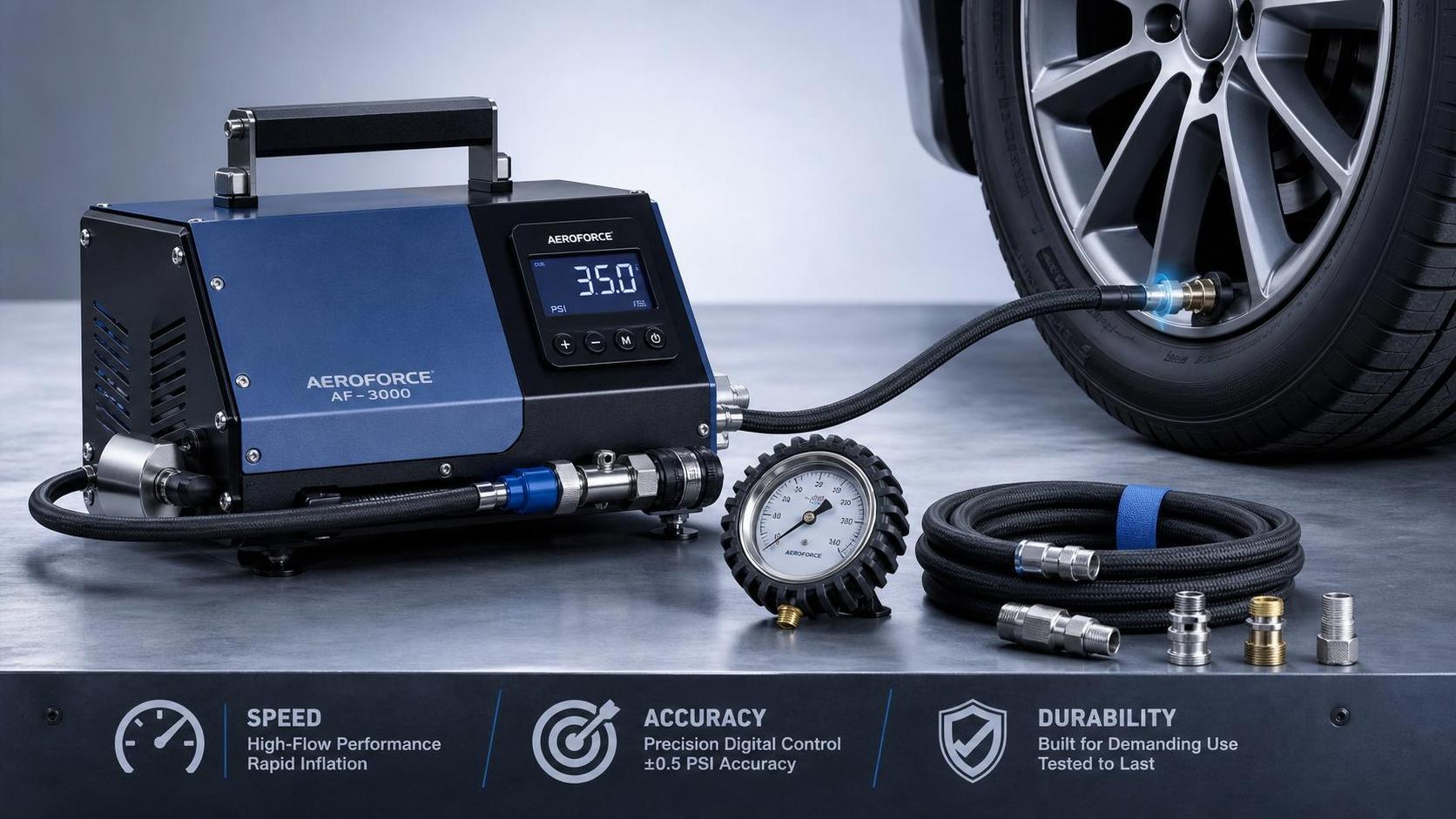
How to Compare Custom Tire Inflator Models for Speed, Accuracy, and Durability
Choosing the right Custom Tire Inflator requires more than checking a pressure range or a motor rating.
Speed, pressure accuracy, and long-term durability shape field performance, warranty risk, and user satisfaction.
That also affects procurement cost over time, especially when volumes increase or custom features are required.
A solid evaluation method helps separate a promising sample from a reliable production-ready Custom Tire Inflator.
Start with the Real Performance Criteria
Basic specifications rarely tell the full story.
For a Custom Tire Inflator, three indicators matter most during model comparison:
- Inflation speed under realistic load
- Pressure accuracy across repeated cycles
- Durability of the pump, electronics, and housing
These three factors are connected.
A faster unit may run hotter.
A very compact design may sacrifice sensor stability or sealing strength.
The best Custom Tire Inflator is usually the model with balanced performance, not the most aggressive single spec.
How to Measure Inflation Speed Correctly
Speed claims can be misleading when test conditions are unclear.
Compare every Custom Tire Inflator under the same tire volume, target PSI, ambient temperature, and power input.
A useful benchmark is fill time from 25 PSI to 35 PSI on a standard passenger tire.
For portable or automotive programs, also test continuous operation after several consecutive inflations.
Watch for performance drop after the third or fourth cycle.
That often reveals motor efficiency limits or poor heat control.
- Record fill time in seconds
- Track current draw and temperature rise
- Check hose and connector heating
- Repeat tests on multiple samples
In practice, a slightly slower model may still be the better Custom Tire Inflator if output remains stable over repeated cycles.
Pressure Accuracy Is More Than a Display Number
Accuracy directly affects user trust.
It also determines whether the Custom Tire Inflator can support higher-end retail, OEM, or fleet requirements.
Use a calibrated external gauge as the reference standard.
Then compare displayed pressure, shutoff pressure, and actual final tire pressure.
A good Custom Tire Inflator should hold consistent tolerance across different pressure bands, not only one test point.
This is where internal component quality becomes visible.
Stable control architecture, sensor matching, and even parts used in related systems like Electronic injection components often reflect a manufacturer's broader engineering discipline.
Durability Testing Should Match the Use Case
Durability cannot be judged from material descriptions alone.
A Custom Tire Inflator for emergency car kits faces different stress than one designed for workshop or fleet service.
Evaluate the full assembly:
- Pump lifespan and motor brush wear
- Hose fatigue and joint leakage
- Switch, display, and PCB protection
- Housing impact resistance
- Performance after heat and vibration tests
Cycle testing is especially important.
Run the Custom Tire Inflator through repeated inflation and cooling intervals, then measure speed and accuracy again.
If performance drifts early, field complaints will usually follow.
Compare Manufacturing Capability, Not Just the Sample
For custom projects, supplier capability matters as much as product design.
A sample can look good while mass production behaves differently.
Qingdao Shinuode Intelligent Technology Co., Ltd. brings over 10 years of manufacturing experience in smart technology products.
Its 5,000 square meter facility, 40 skilled employees, and 30 production machines support stable output and consistent delivery.
More importantly, the company manages R&D, mold design, and mass production in-house.
That reduces outsourcing risk when developing a Custom Tire Inflator with specific casing, software, or packaging requirements.
In-house integration usually helps with cost control, lead time visibility, and faster engineering changes.
That is valuable when procurement plans include private label programs or cross-border drop-shipping support.
A Practical Comparison Checklist
To compare Custom Tire Inflator models efficiently, use a short decision framework:
- Define the target tire size, duty cycle, and power source.
- Test speed under identical pressure and temperature conditions.
- Verify pressure accuracy with a calibrated reference gauge.
- Run repeatability and thermal drift checks.
- Inspect hose, connector, switch, and casing wear points.
- Review factory integration, QC flow, and customization response time.
- Compare warranty exposure against landed cost, not unit price alone.
This approach gives a clearer basis for selecting a Custom Tire Inflator that can scale beyond trial orders.
It also helps identify whether adjacent engineering capability, including experience with Electronic injection components, supports stronger process control across product lines.
Final Decision Focus
When comparing any Custom Tire Inflator, speed gets attention first, but accuracy and durability decide long-term value.
The strongest choice is the model that performs consistently, survives repeated use, and comes from a manufacturer with real production control.
Use measured data, not headline specifications, and the Custom Tire Inflator selection process becomes much more reliable and commercially sound.
Please give us a message