


News
- ▶ Qingdao Shinuode Showcases Next-Generation Portable Power & Air Compressor Solutions at Global Sources Consumer Electronics Show 2026
- ▶ Is it safe to store a cordless SUV tire pump in a hot vehicle?
- ▶ When a portable air pump cannot make a punctured SUV tire safe to drive
- ▶ How accurate is the auto shutoff on a portable air pump for SUV tires?
- ▶ Using a portable air pump to reinflate SUV tires after off-roading
Message
How to Size a 12V Portable Air Pump for Fleet Tire Service Requirements
How to Size a 12V Portable Air Pump for Fleet Tire Service Requirements
Selecting a portable air pump 12v for fleet use is not a matter of choosing the unit with the highest pressure number on the box. A fleet inflator is expected to work when a service vehicle is parked on a roadside, when a driver finds a slow leak before departure, or when a technician needs to restore tire pressure between scheduled maintenance visits. In those moments, inflation speed, electrical stability, usable hose reach, thermal behavior, and repeatable output matter more than a headline PSI rating.
The first decision is to define the pump’s job correctly. A compact 12V inflator can be an effective preventive and emergency tool for passenger cars, light commercial vehicles, and mixed fleets with similar tire sizes. It should not automatically be treated as a replacement for workshop compressors or heavy-duty truck inflation equipment. Procurement problems often begin when an emergency inflator is purchased for a continuous-duty workshop task it was never designed to perform.
Start with the fleet’s actual tire profile
Before comparing models, map the vehicles that will carry or share the pump. Record the typical tire size, normal cold pressure, likely pressure-loss situations, wheel access, and the number of tires a user may need to top up before the unit can be recharged. A passenger-car fleet used for local sales calls has a different requirement from a delivery fleet that runs long shifts with frequent curb contact and more exposure to puncture-related pressure loss.
The important number is not simply the target pressure. It is the pressure increase needed in a realistic tire volume. Raising a tire from moderately low pressure to its operating pressure is far less demanding than inflating a nearly flat tire. Tire volume also changes substantially with width, sidewall profile, and wheel diameter. For that reason, a supplier’s stated inflation time should be read together with the tire specification and test condition. If the test tire is not identified, treat the figure as a reference point rather than a universal fleet-service promise.
A practical purchasing brief should separate three use cases: routine top-up, recovery from low pressure, and emergency inflation after a slow leak has been addressed. The required flow rate, duty cycle, battery reserve, and thermal margin become clearer once these tasks are separated.
Airflow is more useful than maximum pressure alone
Maximum pressure tells you whether the inflator can theoretically reach a given pressure range. It does not tell you how quickly it will move air into a tire. For fleet service, airflow—commonly stated in litres per minute—is usually the more useful starting point. Higher airflow can reduce roadside waiting time, but it must be assessed with the pump’s thermal capacity, motor design, hose losses, and power source.
There is also a difference between airflow measured with little resistance and the effective delivery rate as tire pressure rises. All small compressors work harder near the upper end of their range. A unit that looks fast at low pressure may slow noticeably while approaching a vehicle’s recommended cold pressure. Ask suppliers how their flow claim is defined and request a test relevant to the intended tire category when the order volume or fleet exposure justifies it.
For example, APS-538 is a compact emergency-power format with a 22 mm cylinder and a stated airflow of 33 L/min. Its stated pressure range is 3–150 psi, with psi, bar, kPa, and kg/cm² available on the display. Those specifications make it sensible to evaluate for car-oriented fleet kits, provided the buyer verifies the expected tire size and pressure-recovery task rather than assuming that 150 psi makes it suitable for every commercial vehicle application.
Duty cycle and heat determine whether the pump remains usable
A portable compressor creates heat quickly. That is normal, but heat becomes a procurement issue when the pump must inflate several tires in sequence or operate repeatedly during a shift. Duty cycle describes how long the motor can run and how much rest it needs before the next operation. It is one of the most overlooked criteria in compact inflator sourcing because it is less visible than pressure and battery capacity.
A fleet should decide whether each pump is intended for one driver’s occasional emergency use, a dispatcher’s shared vehicle kit, or a field technician who may support several vehicles. The first use case may prioritize compact dimensions and stored battery energy. The last may require a larger compressor, a direct vehicle-power connection, or a dedicated service solution. A small cordless unit can be excellent in its intended role and still be the wrong tool for repeated tire recovery.
During sample evaluation, run a simple practical test: inflate the relevant tire type, allow the recommended cooling interval, and repeat. Check the housing temperature, displayed pressure stability, hose connection, noise, and whether the unit reaches the set pressure consistently. This tells procurement far more than a brief no-load demonstration.
Choose the power arrangement around operating reality
“12V” can describe different product architectures. Some pumps connect to a vehicle’s 12V accessory outlet. Others use an internal battery and are marketed as 12V-class portable inflators, even though their battery pack operates at a different nominal voltage. The distinction matters because a corded unit depends on vehicle access and outlet condition, while a battery-powered model depends on charge discipline, cell capacity, and charging availability.
For vehicles that may need roadside assistance with the engine off, an internal battery can be valuable. It avoids relying on a functioning accessory socket and allows the inflator to be used away from the vehicle. But fleet managers should establish a charging routine. An inflator stored for months without inspection may be present in the vehicle but unavailable when needed.
Battery capacity should be considered as usable service reserve, not merely a larger number. In the APS-538 configuration, battery options range from 1500 mAh x 4 to 3000 mAh x 4, and the stated charging time is 3–4 hours through a 5V, 2A input. The model also states capacity for 4.5 tires, but buyers should confirm what tire size and inflation condition are used for that claim. Ambient temperature, battery age, starting pressure, and operating breaks can all influence real-world results.
Do not overlook reach, fittings, and user handling
A pump can have adequate airflow and still frustrate users if its hose cannot reach an awkward valve position. Wheel design, valve orientation, parking space, and whether the device sits on the ground or is held in the hand all affect usability. Check hose length, cable length where applicable, connector type, and the ease of attaching the chuck without cross-threading or losing air.
A 40 cm air hose, such as the one specified for APS-538, is compact and convenient for car use, but should be physically checked against the fleet’s wheels before a bulk decision. A 50 cm charging cable is also suitable for charging management, not for powering tire inflation from a distant outlet. These details sound minor in a specification sheet; in a vehicle kit, they often determine whether staff actually use the device correctly.
Digital pressure presets and automatic stop functions can reduce overinflation risk, especially when drivers are not maintenance specialists. Yet the displayed value should be validated against a reliable gauge during sample approval. The question is not whether a display exists, but whether it remains sufficiently consistent across units and after repeated field use.
Consider whether a multi-function unit reduces kit complexity
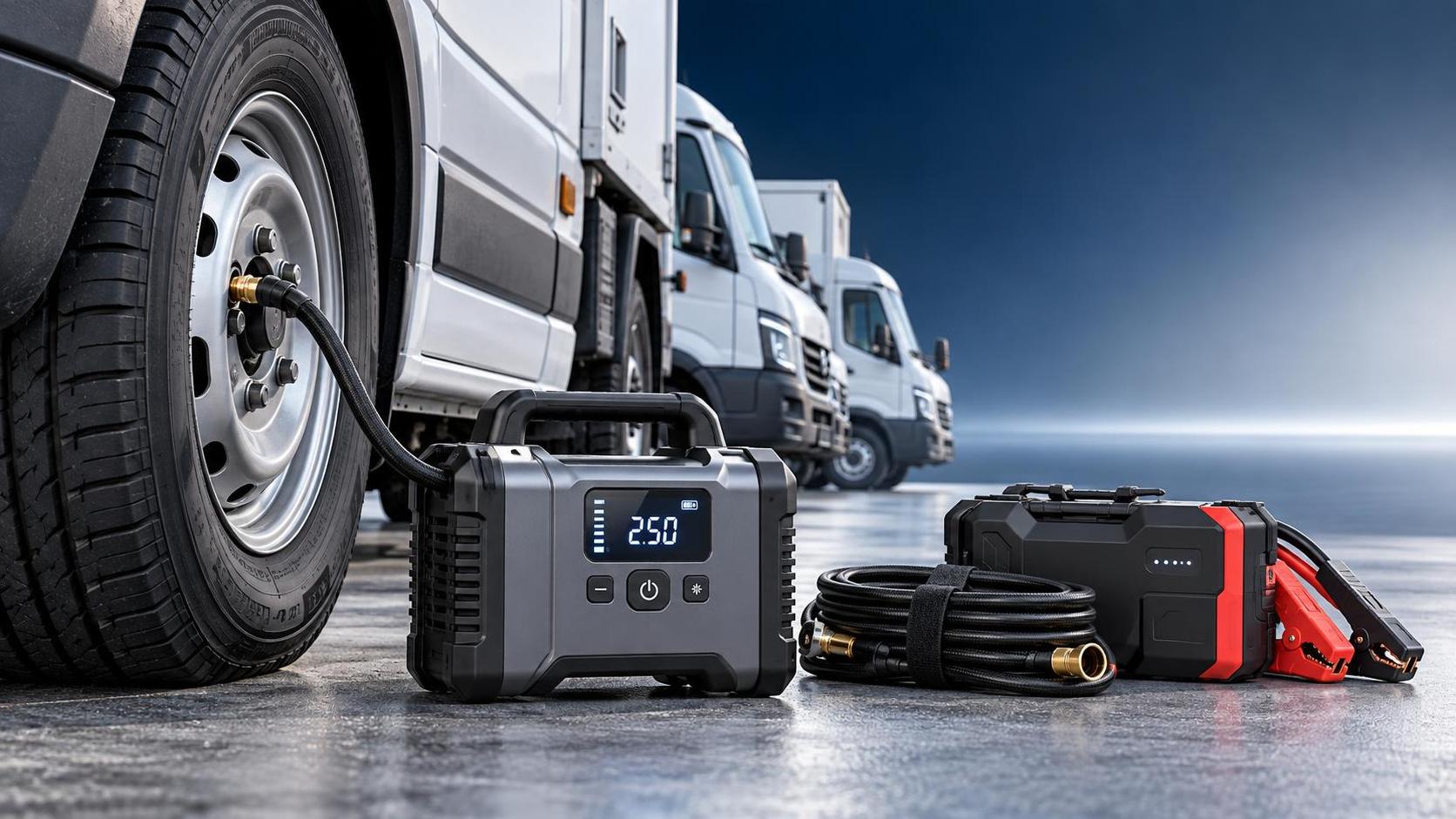
A fleet emergency kit often contains an inflator, jump leads or jump starter, flashlight, charging cable, and warning equipment. Combining functions can reduce the number of loose items that must be checked and replaced. It also creates a trade-off: the battery supporting a jump-start function must retain enough charge for both emergency roles, and staff need clear instructions on periodic charging and safe use.
For car fleets, a product such as the Direct-from-factory 2-in-1 car jump starter and tire inflator—high-capacity emergency power pack with built-in air pump APS-538 can be assessed as an all-in-one vehicle-kit component rather than only as an air pump. It includes an LED light, SOS emergency light, power-bank function, and stated jump-start options of 20, 30, 40, or 50 times depending on battery configuration. That combination may simplify equipment allocation, but the purchasing specification should still define which function has priority and how the device will be maintained.
Build supplier evaluation into the sizing process
The right portable air pump 12v is not only a technical selection. It is a supply consistency decision. For bulk fleet programs, procurement should ask how the product is developed, how components are controlled, what inspection points apply to pressure performance and battery assembly, and whether packaging, manuals, branding, or accessory sets can be adapted without creating unstable lead times.
Qingdao Shinuode Intelligent Technology Co., Ltd. has more than 10 years of manufacturing experience in intelligent auto emergency tools and operates a 12,000㎡ factory. Its in-house chain covers R&D, mold development, and mass production rather than relying on outsourced stages. For buyers managing customized fleet kits, that structure can be relevant when evaluating consistency between approved samples and production orders, as well as cost control for tailored packaging or configurations. Domestic bulk supply and cross-border dropshipping are also available, although delivery planning should always be confirmed against the destination, order structure, and current project schedule.
Before issuing a purchase order, request samples from the proposed production configuration—not an unrelated showroom version. Confirm battery option, display units, nozzle set, labeling, carton count, packing dimensions, and any destination-specific documentation requirements. APS-538 is specified at 16 pieces per master carton, with customization available for the color box; these logistics details can affect warehouse handling and last-mile replenishment even when the product itself is compact.
A sensible final specification
A useful fleet specification describes the task, not just the product category. State the vehicle types, tire pressure range, anticipated inflation events per charge or shift, required inflation-time benchmark, preferred power arrangement, minimum hose reach, acceptable cooling interval, pressure-display units, storage conditions, and package contents. Add an acceptance test based on the actual fleet tire rather than a generic “works normally” inspection.
For light vehicles, a compact cordless inflator with adequate airflow, controlled shutoff, and a maintained battery reserve may be the most practical answer. For repeated service calls or larger commercial tires, it is usually wiser to step up to equipment designed for longer operation. Sizing correctly means matching the pump to the duty that will occur on the road—not the most impressive number in a comparison chart.
Please give us a message