


News
- ▶ Key Testing Checks Before Buying 12V Portable Air Pumps in Volume
- ▶ Comparing 12V Portable Air Pump Power Draw for Mobile Service Fleets
- ▶ Preventing Blown Fuses When Using a 12V Portable Air Pump on Vehicles
- ▶ 12V Portable Air Pump Duty Cycle: What It Means for Field Reliability
- ▶ How to Size a 12V Portable Air Pump for Fleet Tire Service Requirements
Message
Portable Tire Inflator Procurement Checklist for Private Label and Bulk Orders
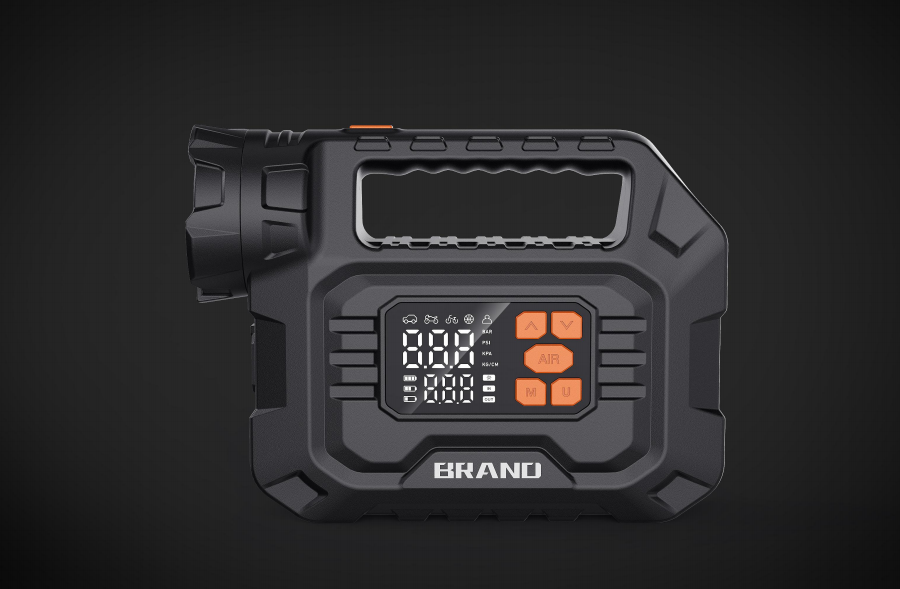
Start with the order model, not the quoted unit price
When buying a Portable Tire Inflator for private label or bulk supply, the cheapest quote is rarely the lowest-cost option. Procurement problems usually show up later: inconsistent pressure performance, delayed packaging approval, rework on labels, missing accessories, or shipment timing that breaks your sales plan. A workable checklist should help you screen suppliers before those costs appear.
For this category, I would separate the job into three questions: can the factory build consistently, can it customize without confusion, and can it keep delivery stable when volumes change. If you do not get clean answers to those three, price comparison is premature.
Check whether the supplier is a manufacturer or mainly a trader
This sounds basic, but it affects almost everything: lead time, mold changes, cost control, and how fast technical issues get resolved. Ask what part of the process is handled in-house. For a Portable Tire Inflator program, the useful checkpoints are product development, mold work, assembly, and mass production control. If key steps are outsourced, your sampling cycle and repeat orders usually become less predictable.
A factory with its own development and production chain is usually better positioned to manage customized orders and keep product consistency from one batch to the next. That matters more than polished sales language.
Confirm what “same product” actually means in the quote
Inflators that look similar on a product sheet can differ in motor setup, pressure range, cable quality, nozzle set, battery-related functions, housing material, carton spec, and included accessories. A buyer comparing three suppliers without locking these details is not comparing like for like.
- Target application: passenger car only, or broader emergency use.
- Pressure specification and display format.
- Accessory pack included in the base price.
- Private label scope: logo, color box, manual, outer carton marks.
- Testing standard used for pre-shipment inspection.
If any of these are left vague, the quote may look competitive at first and become expensive during order execution.
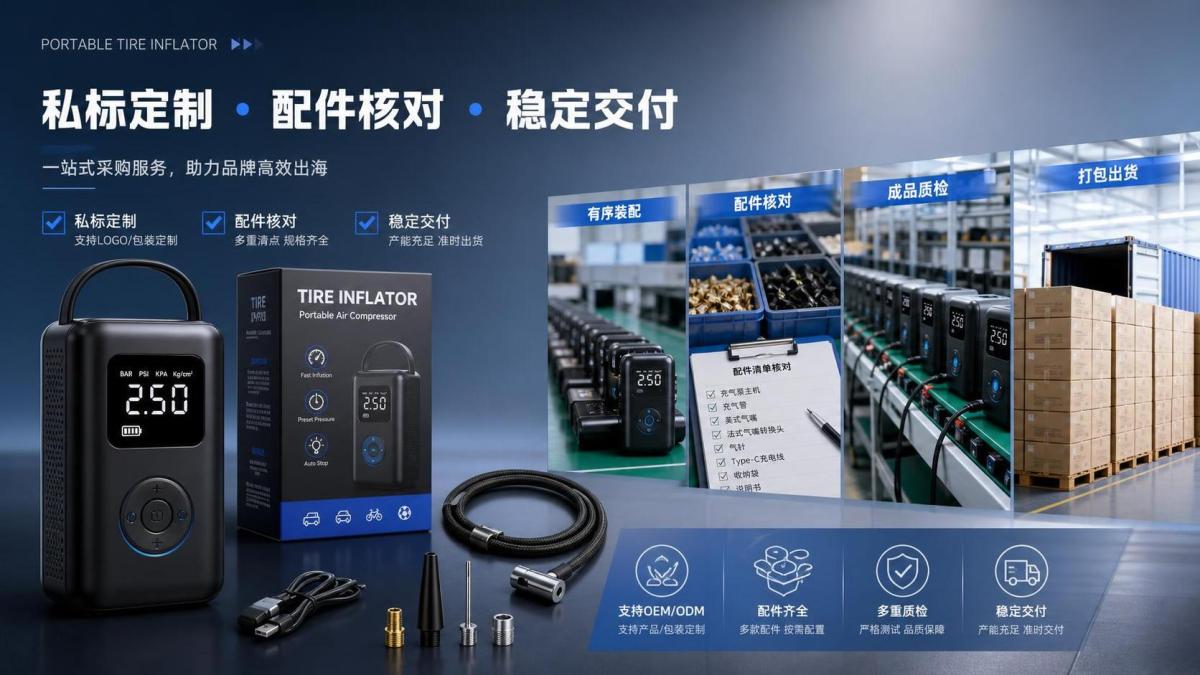
Review the quality checkpoints that matter in real use
For procurement teams, “quality” should be translated into failure points that create returns or complaints. In this product class, the practical checks are pressure accuracy, inflation speed consistency, hose and connector durability, power stability, heat management during operation, and packaging protection during transport.
Do not stop at asking whether the product is tested. Ask what is tested on incoming materials, during assembly, and before shipment. The answer should be specific enough to show the factory has a routine, not just a final visual inspection. If the supplier can only talk about finished goods, you still do not know where defects are being prevented.
Look closely at customization workflow
Private label orders often go wrong in the boring parts: artwork version control, carton text, language layout, barcode placement, and accessory packing. Ask for the approval flow in order. You want to know who handles artwork review, how sample confirmation is recorded, and whether packaging files are matched to the production order before mass run.
This is where an integrated manufacturer usually has an advantage. When R&D, mold development, and mass production are coordinated internally, change requests move faster and there are fewer handoff errors. That is especially useful when your order includes custom branding or when you need to adjust packaging for different sales channels.
Treat lead time as a capacity question
Many buyers ask for lead time once and write it into a spreadsheet as if it were fixed. It is not. The right question is what conditions the lead time depends on. New mold work, packaging confirmation, peak-season capacity, accessory sourcing, and order quantity all change the timeline.
Ask the supplier to separate sample timing, packaging preparation, production time, and shipment readiness. That gives you a more useful view than one total number. It also helps expose whether the factory has enough control over its own schedule.
Use one comparison table for total procurement cost
This table is where weak quotes usually get exposed. A slightly higher unit price from a factory with better process control can be cheaper over two or three repeat orders.
Check whether the product roadmap fits your channel
Some buyers need a basic standalone inflator. Others want multi-function emergency tools because they sell better in bundled automotive categories. If your channel values compact utility and higher perceived value, it may make sense to review combined products such as OEM Heavy Duty Jump Starter With Air Pump 150 PSI Super Fast Tire Inflator Car Battery Booster Jumper Starter for car APS-336. The key is not to add features for marketing copy alone. Extra functions only help if they match your target price band, package size expectations, and return-risk tolerance.
Do a small-batch thinking exercise before placing a large order
Even if you plan to buy in volume, ask how the supplier handles lower-volume runs, replenishment orders, and model variations. This tells you a lot about flexibility. Factories that support both bulk supply and smaller cross-border fulfillment models are often more practical partners when your demand pattern is uneven or when you are testing a new private label line.
You are not only buying the first order. You are testing how the supplier behaves when the order gets more complicated than the forecast sheet suggested.
What to lock before issuing the PO
- Approved sample or approved specification sheet tied to the PO.
- Final packaging files and accessory list.
- Inspection checkpoints and defect handling method.
- Lead time split by sampling, production, and shipment readiness.
- Clear quotation boundary, including what is not included.
If I had to shorten the whole checklist into one rule, it would be this: choose the Portable Tire Inflator supplier that gives you the fewest operational surprises after payment, not the one that wins the first spreadsheet comparison. For procurement, stable quality, clean customization control, and dependable delivery are where the real savings show up.
Please give us a message