


News
- ▶ USB-C or Removable Battery: Which Cordless Air Pump Design Works Best?
- ▶ Why Cordless Portable Air Pumps Lose Pressure Accuracy During Long Jobs
- ▶ Cordless Portable Air Pumps: Battery Capacity Needed for Daily Use
- ▶ When Is a 12V Portable Air Pump Better Than a Shop Compressor?
- ▶ Key Testing Checks Before Buying 12V Portable Air Pumps in Volume
Message
What Pressure Accuracy Should You Expect From a Portable Tire Inflator?
For a technical evaluator, pressure accuracy on a Portable Tire Inflator is not a minor spec. It affects whether the unit stops at the intended pressure, how much trust an end user places in the display, and whether repeated inflation cycles stay consistent across production batches. In practical terms, most buyers are not asking for laboratory-grade precision. They are asking whether the inflator can deliver a reading and shutoff point close enough to support safe tire service in roadside and routine maintenance conditions.
A useful way to assess this is to stop looking at accuracy as a single marketing claim. Check the sensor, the calibration method, the test conditions, and how stable the product remains when voltage, temperature, and runtime change. That is where the real answer sits.
Start with the number, then challenge what it actually means
When a supplier gives a pressure accuracy figure, the first question is simple: accuracy relative to what reference, and under which conditions? A stated tolerance without a test basis is weak information. For Portable Tire Inflator evaluation, what you want to see is whether the displayed pressure and the actual tire pressure remain close within a defined pressure range, not only at one point.
In many buyer reviews, an acceptable field expectation is usually framed as the inflator reading being close enough to a trusted external gauge that the user does not need major correction after inflation. The technical check is less about one perfect number and more about repeatability. If unit A stops at 35 psi today, unit B from the same batch should not routinely stop at 37 while another stops at 33 under the same setup.
- Ask for the pressure tolerance across the working range, not only at a single target point.
- Check whether the value refers to sensor reading accuracy, final tire pressure accuracy, or auto-stop cutoff accuracy. These are related, but not identical.
- Watch for claims that mix display resolution with actual measurement accuracy. A screen showing 0.1 psi steps does not prove the internal measurement is accurate to 0.1 psi.
Check the pressure range where the inflator stays reliable
Some inflators behave reasonably well in the middle of their operating range and drift more at the low or high end. For passenger car use, that may not immediately cause trouble, but for a technical evaluation it matters. A Portable Tire Inflator intended for broad automotive emergency use should be checked around the pressures it is likely to serve most often, not just at an easy benchmark.
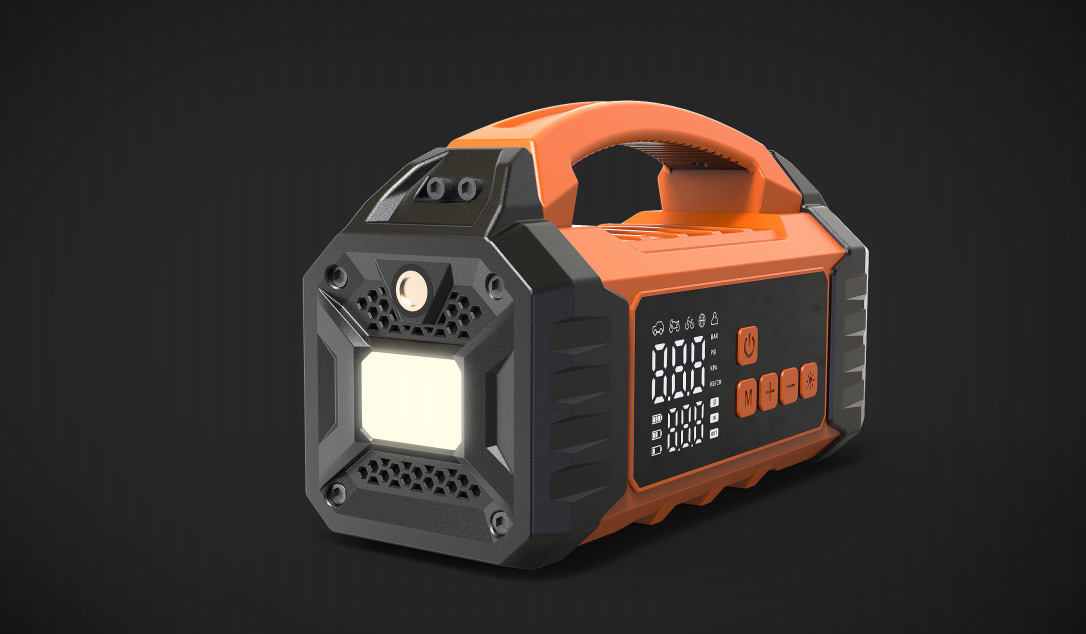
This is especially relevant when the product combines multiple functions. A unit such as Heavy Duty Super Fast Tire Inflator Car Jumper Battery Booster Power Bank Jump Starter With Air Pump APS-357 may be evaluated not only as an air pump, but as part of a compact roadside emergency tool. In that case, pressure performance under battery-powered operation becomes part of the review, because the inflator is not working in isolation.
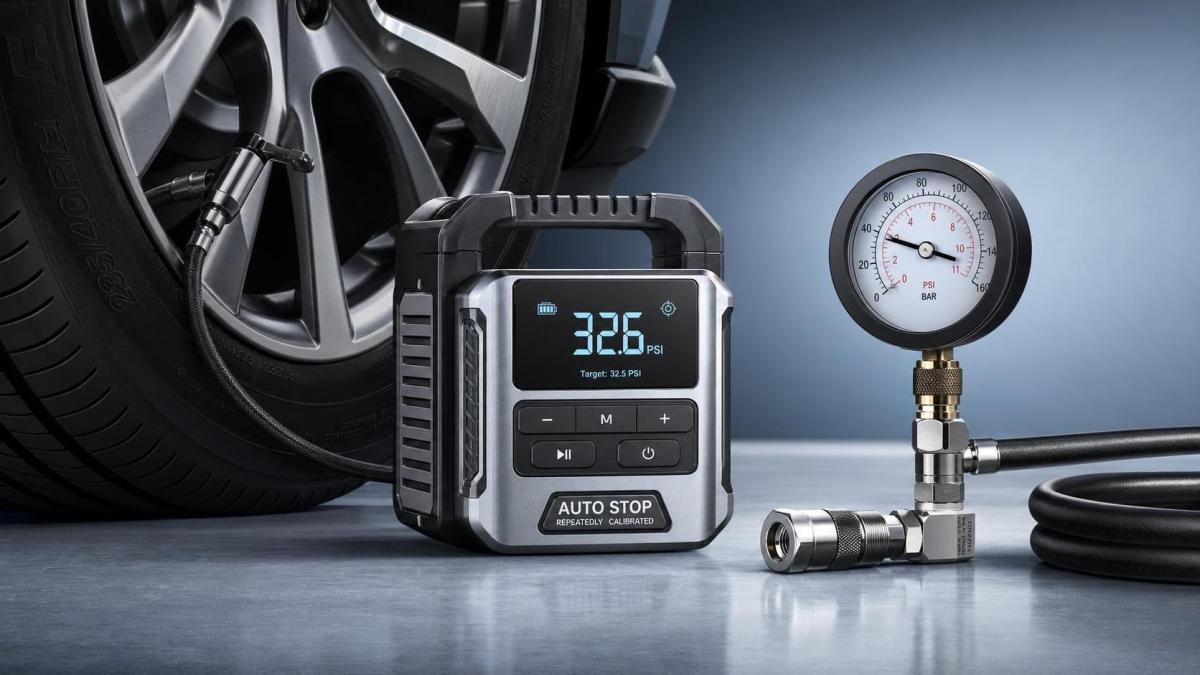
A good test plan checks at several setpoints across the realistic use band. That gives you a better picture of whether the pressure control is genuinely stable or just acceptable in a narrow window.
Separate sensor accuracy from system accuracy
This is where many evaluations go wrong. The pressure sensor may be decent, while the full inflation system still overshoots or undershoots because of airflow lag, valve response, hose volume, heat buildup, or software timing. If you only compare the displayed value during pumping, you may miss what happens at shutoff.
A better checklist includes two separate judgments:
- How close is the displayed pressure to a trusted reference gauge during measurement?
- How close is the final tire pressure to the selected target after the cycle ends and the system settles?
Those two answers can differ. A product with a clean-looking screen and fast inflation may still produce a larger final-pressure deviation than expected if the control logic is not tuned well.
Review test conditions before trusting the result
Pressure accuracy is sensitive to operating conditions. If the inflator is battery-powered, supply voltage matters. If the compressor runs continuously, heat matters. If the test line or tire starts at a very different temperature from ambient, that also changes what you see.
When comparing suppliers, ask how the accuracy check was performed. The minimum useful details are:
- Power state: fully charged battery, vehicle power input, or another source
- Ambient temperature and whether the unit was already warm from prior use
- Reference gauge type used for comparison
- Number of repeated cycles at the same setpoint
- Whether the reading was taken during inflation or after pressure stabilization
Without those conditions, two inflators can appear different when the real issue is that they were measured differently.
Look for manufacturing consistency, not just one good sample
For sourcing teams and technical evaluators, sample accuracy is only the first gate. The larger risk is lot-to-lot variation. Pressure performance can shift if sensor sourcing changes, calibration steps are uneven, or assembly tolerances on the air path are not controlled well.
This is why manufacturer process control matters in the background. A factory with in-house development, tooling, and production control is generally in a better position to maintain stable output than one relying on fragmented outsourcing, especially for products that combine electronics, pumping hardware, and control logic. That does not replace testing, but it changes how much confidence you can place in repeat orders.
Ask for batch sampling logic. Not a sales promise. A real sampling approach.
Common evaluation mistakes that distort the accuracy verdict
A few mistakes show up repeatedly in inflator reviews and create bad conclusions:
- Using an unknown reference gauge. If the comparison instrument is unreliable, your result is weak from the start.
- Judging accuracy by one inflation cycle. You need repeated runs to see drift and overshoot behavior.
- Ignoring disconnect loss. Some apparent inaccuracy comes from pressure release during hose removal, not the compressor itself.
- Testing only when the battery is fresh. A multifunction unit may behave differently as available power drops.
- Reading the screen as if it were the final tire condition. Final pressure needs to be verified separately.
What an evaluator should expect in practice
Expect a Portable Tire Inflator to provide pressure control that is consistent, repeatable, and close enough to the target that only minor correction is needed when checked with a reliable external gauge. Expect the supplier to explain how that result is measured. Expect the final tire pressure to stay reasonably aligned with the setpoint across normal use conditions, not just in a single ideal test.
Do not expect a meaningful accuracy judgment from screen resolution, maximum pressure claims, or inflation speed alone. Those are separate attributes. A fast unit can still be sloppy at cutoff, and a multifunction emergency device can still be worth considering if its pressure performance remains stable through repeated, well-controlled testing.
If you are building a comparison sheet, keep the order tight: verify the reference gauge, test several pressure points, repeat the same cycle multiple times, measure final tire pressure after disconnect, and then compare batch consistency. That sequence will tell you far more than a headline tolerance ever will.
Please give us a message