


News
- ▶ Qingdao Shinuode Showcases Next-Generation Portable Power & Air Compressor Solutions at Global Sources Consumer Electronics Show 2026
- ▶ Is it safe to store a cordless SUV tire pump in a hot vehicle?
- ▶ When a portable air pump cannot make a punctured SUV tire safe to drive
- ▶ How accurate is the auto shutoff on a portable air pump for SUV tires?
- ▶ Using a portable air pump to reinflate SUV tires after off-roading
Message
Which 12V requirements matter when sourcing a Car Tire Inflator?
Which 12V Requirements Matter When Sourcing a Car Tire Inflator?
“12V” is one of the first terms buyers see when evaluating a Car Tire Inflator, but it is also one of the easiest specifications to misunderstand. A 12V label may refer to a vehicle cigarette-lighter input, a nominal vehicle electrical system, or simply the product category shoppers expect to find online. It does not, by itself, confirm inflation speed, motor durability, pressure accuracy, or safe operation.
For distributors and agents, this matters because returns often come from a gap between the retail promise and the actual use case. A compact inflator may work well for topping up a passenger-car tire but disappoint a customer trying to reinflate a fully flat SUV tire. Another model may show “150 PSI” on its display while having a limited continuous operating time that makes that headline figure less useful in real roadside conditions.
The right sourcing decision starts with a more practical question: what must the 12V inflator do, under which conditions, and for which vehicle mix? Once that is clear, the important electrical and mechanical requirements become easier to compare.
Start by separating 12V input from 12V market positioning
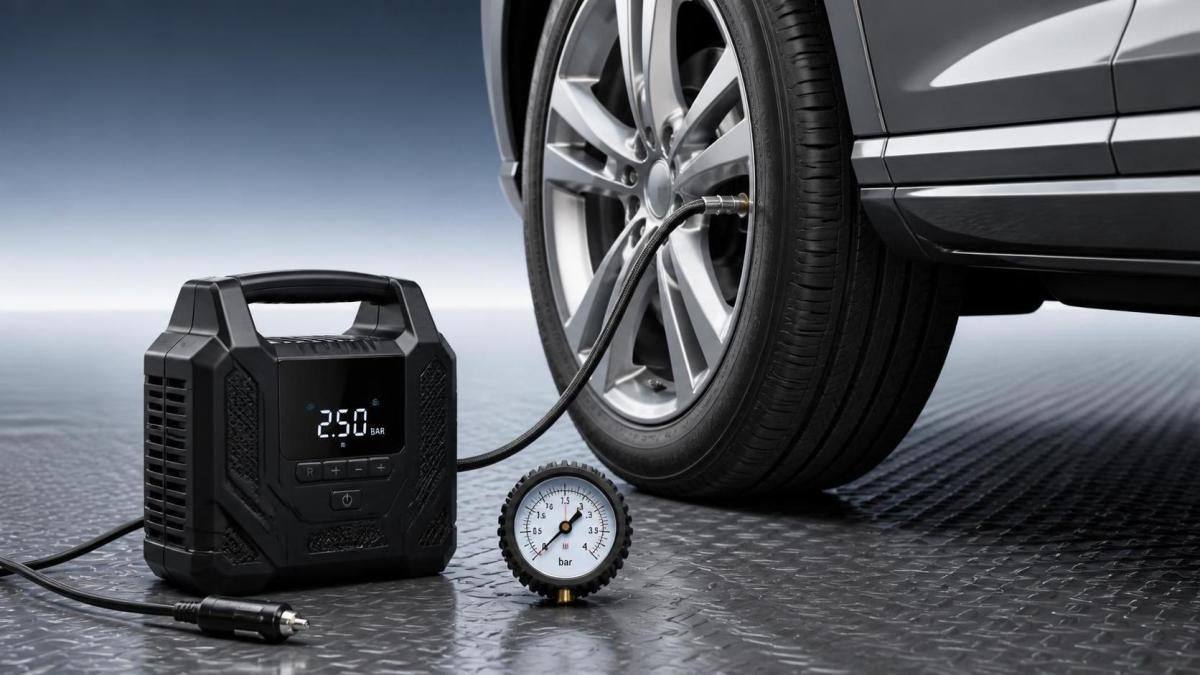
A conventional 12V car tire pump is powered through a vehicle accessory socket. In practice, a running vehicle’s electrical system is commonly above 12V, so sourcing documents should state an acceptable input-voltage range rather than relying only on “12V” printed on the package. The supplier should also clarify whether the unit is intended only for a standard accessory socket or can be supplied with battery-clamp leads for direct connection.
This distinction affects power availability. A tire inflator that draws substantial current can overload a vehicle socket fuse, especially in older vehicles or when the pump is started with the engine off. Buyers should request the rated current, maximum current, fuse specification, cable gauge, and recommended operating condition. “Use with engine running” is not decorative wording; it can reduce the chance of draining the vehicle battery during a longer inflation task.
Cordless emergency tools require a different reading of the specification. Their internal battery pack may operate at 14.8V or another nominal battery voltage, while the product is still sold into the broader vehicle emergency-accessory market. That is not a contradiction, but it should be communicated accurately. Do not market an internal-battery inflator as a cigarette-lighter-powered 12V pump unless it genuinely supports that connection.
The power path determines real inflation performance
Inflation speed is not just a number on a sales sheet. It reflects the motor, cylinder, power supply, thermal design, hose restriction, and the pressure level being measured. Airflow stated in litres per minute is useful, but it should be read with context. Some suppliers quote free-air flow, which is measured with little or no back pressure. A pump slows down as tire pressure rises, so the more relevant sourcing question is how long it takes to raise a defined tire size from a stated starting pressure to a stated final pressure.
Ask for a repeatable test condition. For example: passenger-car tire size, initial pressure, target pressure, ambient temperature, and whether the vehicle engine is running for a plug-in model. Without those details, comparing “fast inflation” claims between factories becomes guesswork.
Cylinder diameter is one useful mechanical indicator, though not a complete answer. A larger cylinder can support higher displacement, but motor power and heat control still decide whether the pump can sustain that output. For a compact emergency product, there is always a trade-off between body size, noise, airflow, and duty cycle. Buyers should be wary of expecting workshop-compressor performance from a handheld unit designed to fit in a glove box.
Duty cycle is often more important than maximum PSI
Many customer complaints are really thermal-management complaints. A small 12V compressor can become hot quickly when inflating from a low pressure, particularly in warm weather. If the motor protection cuts in after a few minutes, the unit may still be technically functional, but it is not suitable for the use case the buyer had in mind.
Request the permitted continuous run time, cooling interval, and the behavior of the over-temperature protection. These should be matched to the intended retail channel. A low-cost emergency inflator for occasional pressure top-ups can reasonably have a shorter duty cycle. A product positioned for road trips, fleet vehicles, SUVs, or van owners needs more margin. There is no universal “best” duty cycle; there is only a fit between the design and the promise on the carton.
Maximum pressure should be assessed the same way. Passenger-car tires generally do not require anything near the highest pressure printed on many inflators. A broad pressure range can be helpful for bicycles, motorcycles, sports equipment, and some other applications, but high-pressure capability should not distract from the pump’s ability to work consistently in the pressure range customers use most.
Pressure measurement and auto-stop need practical verification
Digital preset pressure is now expected in many channels, but it is only useful if the sensor, display, and shut-off logic work together reliably. Buyers should check whether the pressure reading is taken before the motor begins, while the motor is running, or after it stops. Small fluctuations are normal in compact pumps, yet a major difference between the displayed value and a verified external gauge will quickly damage trust in the brand.
The most sensible inspection is not a quick bench test on one sample. Set several target pressures, run repeated cycles, and compare results with a suitable reference gauge. Test the supplied valve connector as well. A loose screw-on connector can leak enough air to make the reading appear unstable, while a poor clamp connector may be difficult to use in tight wheel spaces.
Pressure-unit selection also depends on destination market. PSI is familiar in some markets, while BAR and kPa are commonly requested elsewhere. A multi-unit display is practical for international distribution, provided the packaging, instructions, and default setting are clear. Confusion over units is a preventable support issue.
Cord length and hose length are not minor accessories
A 12V inflator may meet every electrical requirement and still be awkward to use if the power cable cannot reach the farthest tire. This problem appears frequently with SUVs, sedans with rear-mounted sockets, and vehicles where the accessory outlet is positioned near the dashboard. Measure reach with the cable routing a real user would take, not in a straight line across an empty workbench.
The air hose also deserves attention. A very short hose may force the user to hold the unit off the ground or place it too close to a hot wheel area. A longer hose adds convenience but must be stored without sharp bends that shorten service life. Buyers should inspect strain relief at both the hose and power-cable entry points. These are common fatigue areas because the product is repeatedly pulled from vehicle storage, uncoiled, and packed away again.
Safety features should be matched to likely misuse
For a vehicle-powered model, key protections may include a correctly rated plug fuse, short-circuit protection, reverse-polarity protection where battery clamps are used, and over-temperature shutdown. A cordless model adds battery-management questions: charging protection, output protection, charging input behavior, and battery-cell consistency. The exact compliance obligations vary by market and product configuration, so importers should verify applicable local requirements with the supplier’s current technical files rather than assuming one document covers every destination.
Instructions should also acknowledge the limits of emergency inflation. An inflator is useful for restoring pressure after a slow leak or for routine top-up, but it does not repair a damaged tire. Clear wording about checking the tire, avoiding unattended operation, and allowing the unit to cool is more valuable than a page of generic warnings.
Evaluate all-in-one units as systems, not as a bundle of icons
Multi-function emergency tools can make sense when shelf space and vehicle-storage space are limited. They also create more interfaces to assess. If a product combines an air pump, jump starter, flashlight, SOS light, and power bank, buyers should ask how the battery capacity is allocated and whether repeated pumping affects the reserve needed for an emergency start.
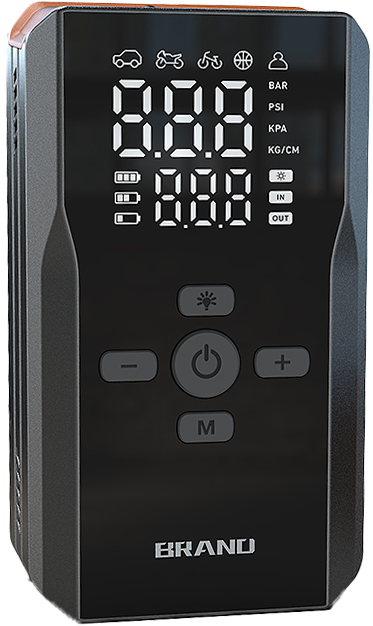
One example is the All-in-One Jump Starter and Tire Inflator APS-543. Its listed internal working voltage is 14.8V, so it should be evaluated as a cordless emergency tool rather than treated as a standard 12V socket inflator. The stated 22 mm cylinder, 33 L/min airflow, 3–150 PSI pressure range, and four selectable pressure units give buyers concrete points for comparison. Its specified 40 cm air hose and 50 cm charging cable are equally relevant when checking everyday usability. Battery configurations range from 1500mAh × 4 to 3000mAh × 4, with corresponding emergency-start claims that should be assessed against the intended vehicle segment and test procedure.
The attraction of this type of unit is obvious: fewer separate products to carry. The sourcing discipline should be equally obvious: test the pump after storage, test charging and USB output, test the lighting functions, and verify that the jump-start function remains available after realistic use of the compressor. A feature-rich unit is only valuable when each major function is dependable.
Factory control matters when specifications are customized
Customization often begins with color boxes, logos, language versions, and accessory sets. It can also affect the product more deeply: cable length, plug type, pressure-unit defaults, battery configuration, mold details, and packaging protection. Each change should have a documented sample confirmation process. A longer cable, for example, is not merely a packaging decision; it may affect voltage drop, winding space, and cost.
For buyers needing repeatability across bulk orders, it is worth asking where design, molding, assembly, and quality checks are handled. Qingdao Shinuode Intelligent Technology Co., Ltd. operates a 12,000㎡ factory and describes an in-house chain covering R&D, mold development, and mass production for intelligent auto emergency tools. That kind of production structure can be useful for customized programs because fewer handoffs generally make it easier to trace revisions, control packaging changes, and align production timing. It does not remove the need for approved samples and inspection criteria, but it makes those controls more workable.
Before placing a larger order, define the acceptance points in plain language: input method, current rating, inflation test condition, pressure-display tolerance, auto-stop behavior, permitted run time, accessory contents, label language, and carton marks. If a supplier cannot answer these questions clearly, a low unit price will not compensate for the support burden later.
A sound 12V decision is about fit, not the largest number
The best Car Tire Inflator for a distribution line is rarely the one with the most aggressive PSI claim or the longest feature list. It is the one whose electrical input, current draw, heat behavior, cable reach, pressure control, and safety design are appropriate for the vehicle owners you intend to serve. Confirm the operating conditions behind every headline specification, especially when comparing a plug-in 12V model with a cordless unit using a higher-voltage internal battery.
That approach produces a more accurate product listing, a more defensible purchasing decision, and fewer unpleasant surprises when the inflator is finally used beside the road rather than on a showroom table.
Please give us a message