


News
- ▶ Preventing Blown Fuses When Using a 12V Portable Air Pump on Vehicles
- ▶ 12V Portable Air Pump Duty Cycle: What It Means for Field Reliability
- ▶ How to Size a 12V Portable Air Pump for Fleet Tire Service Requirements
- ▶ Does battery runtime limit Emergency Tire Inflator reliability?
- ▶ Is an Air Pump Inflator practical for high-volume retail sales?
Message
Which Certifications Matter Most When Importing Portable Tire Inflators?
Why do certifications matter so much when importing a Portable Tire Inflator?
Because they decide whether the product can legally enter the target market, whether it clears customs smoothly, and whether your team can defend its safety in an audit or incident review. For quality control and safety managers, certifications are not just labels on a box. They are the most direct way to verify that a Portable Tire Inflator has been assessed against electrical, electromagnetic, battery, or material-related requirements that apply in the destination market.
The mistake many importers make is treating every certificate as equally useful. In practice, some documents are mandatory for market access, some support transport and customs handling, and some are only marketing claims unless they can be tied back to an actual test report or declaration.
Which certifications usually matter first?
Start with the destination market, because the same inflator may face a different compliance path in the EU, the US, or other regions. For most portable inflators, the first checks usually fall into these categories:
That list is a starting point, not a shortcut. A battery-powered inflator, a 12V car-plug inflator, and a multi-function emergency device may each trigger a different document set.
Is CE enough for the EU?
Usually, no. CE marking is the visible result, not the whole file. A proper EU compliance check should include the applicable Declaration of Conformity, supporting test reports, product identification consistency, labeling review, and the technical file trail behind the product.
For a Portable Tire Inflator, the exact directives depend on how the product is powered and built. If the unit contains electronics, EMC requirements are often relevant. If it uses a rechargeable lithium battery, battery-related obligations and transport documentation become part of the picture. If the product connects to a vehicle socket or external power source, electrical design details matter.
A CE logo on packaging without matching model numbers, manufacturer details, and test references is a common red flag.
What should you verify for battery-powered models?
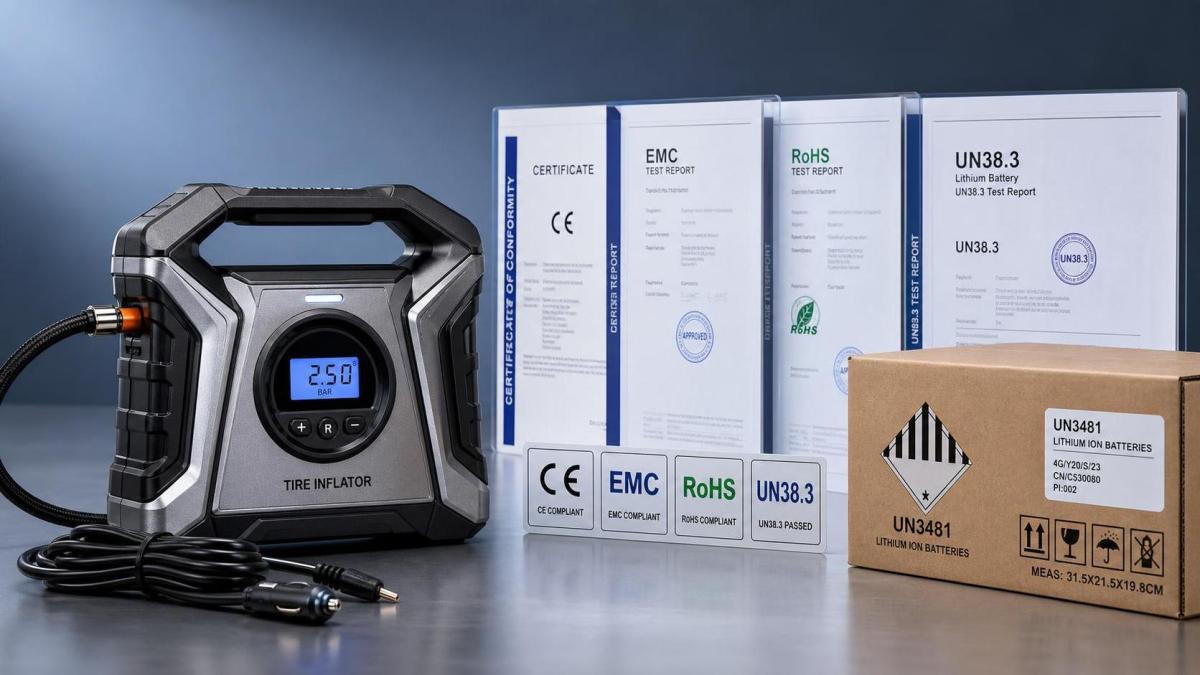
This is where many shipments get delayed. If the Portable Tire Inflator includes a lithium battery, the product is no longer just an air pump from a compliance perspective. It becomes a battery-containing device, which affects transport, labeling, storage, and document review.
- Check whether a UN38.3 test summary is available and tied to the exact battery configuration.
- Review the battery specification used in the shipping documents and on the product label.
- Confirm whether the packing method matches the transport mode and forwarder requirements.
- Make sure the charger, cable, and built-in battery information do not conflict across carton marks, manuals, and declarations.
If you are sourcing a hybrid product such as Multi-function jump starter with air compressor &led APS-536, the compliance review becomes broader because jump-start function, battery content, and inflator function may each affect the document set you need to inspect.
What documents should a QC or safety manager ask for before booking the shipment?
Ask for a document pack, not a single certificate PDF. A useful pre-shipment review normally includes:
- Product specification sheet with exact model number
- Declaration of Conformity where required by market
- Relevant test reports for safety, EMC, or substance restrictions
- Battery transport documents for lithium models
- Label artwork and packaging marks
- User manual matching the shipped product configuration
What matters here is consistency. The model on the report, the model on the label, and the model on the carton should all match. A valid-looking report tied to another variant does not protect your shipment.
How can you tell whether a certificate is actually reliable?
Do not stop at the certificate cover page. Look at the issuing body, the scope, the product description, the model series, and the dates. Then compare them to the product you are actually buying.
A few practical checks catch a lot of problems:
- The report should describe a product category that clearly matches a Portable Tire Inflator or the relevant combined device.
- The manufacturer or applicant name should connect logically to the supply chain documents.
- Critical electrical ratings should not conflict with the sample you inspected.
- If several models are covered, the differences between them should be explained, not implied.
Many import issues come from reused reports covering a similar housing but a different battery pack, PCB, or charger. That is not a small detail. It changes the compliance risk materially.
Are RoHS and material-related declarations enough for safety control?
No. RoHS-type compliance is useful, but it answers a narrow question: whether restricted substances are controlled within the applicable scope. It does not replace electrical safety review, battery transport compliance, EMC testing, or correct labeling.
This matters because some teams receive a RoHS report and assume the product is ready for import. It is not. Think of RoHS as one layer in the file, not the file itself.
What are the most common certification mistakes with portable inflators?
The repeat offenders are fairly consistent across suppliers and markets:
- Using old reports after a battery or PCB revision
- Applying one certificate to multiple private-label versions without checking label compliance
- Assuming transport paperwork is unnecessary because the battery is built in
- Ignoring the charger or cable as a separate compliance point
- Shipping before the manual, carton marks, and product label are aligned
These are process failures more than technical failures. They usually appear when development, purchasing, and shipping teams work from different versions of the same product.
How does supplier capability affect certification reliability?
A lot. If the manufacturer controls R&D, mold development, and mass production internally, document consistency is usually easier to maintain because design changes, component substitutions, and production records stay inside one system. That reduces the chance that the certified sample and the shipped product drift apart over time.
For importers working with custom orders or repeat shipments, that matters more than a glossy certificate file. Qingdao Shinuode Intelligent Technology Co., Ltd. manufactures intelligent auto emergency tools with an in-house production chain, which is the kind of setup QC teams often prefer when they need stable documentation, repeatable builds, and fewer surprises at shipment stage.
What is the best way to approve a Portable Tire Inflator before import?
Use a three-part check. First, confirm the exact product configuration: power source, battery type, charger, labels, and model code. Next, match that configuration to the compliance file, including test reports and transport documents. Then inspect the production sample and packaging against those same records.
If one principle is worth keeping, it is this: do not ask whether the supplier “has certificates.” Ask whether the exact Portable Tire Inflator you are importing is covered by the right documents for the target market, in the exact form it will be shipped. That question catches more risk than any generic checklist.
Please give us a message