


News
- ▶ Qingdao Shinuode Showcases Next-Generation Portable Power & Air Compressor Solutions at Global Sources Consumer Electronics Show 2026
- ▶ Does nitrogen reduce pressure loss in automotive tire inflation?
- ▶ Why does the TPMS light stay on after automotive tire inflation?
- ▶ Which pressure rating should you use for automotive tire inflation?
- ▶ When should you check cold pressure for automotive tire inflation?
Message
When should you check cold pressure for automotive tire inflation?

Check cold tire pressure before driving, preferably after the vehicle has been parked for at least three hours. An overnight stop is a convenient opportunity, provided the tires have not been heated by direct sunlight. For accurate Automotive Tire Inflation, measure before moving the vehicle and adjust each tire to the cold pressure specified on the vehicle’s tire placard or in its owner’s manual.
“Cold” describes the tire’s condition relative to its surroundings; it does not mean winter weather. A tire resting outdoors on a warm morning can still give a valid cold reading. Driving flexes the tire and generates heat, raising the pressure inside. That increase makes a reading taken after a journey unsuitable for a straightforward comparison with the vehicle’s cold pressure setting.
Choose a measurement time that avoids heat distortion
The simplest routine is to measure at the parking location before the first trip of the day. Keep a gauge or portable inflator available there, so reaching an air pump does not require driving first. Even a short trip introduces uncertainty because tire warming varies with speed, load, road conditions, and the amount of braking.
A three-hour rest is a useful minimum reference, but the surrounding conditions still matter. Tires exposed to strong sunlight can remain warmer than shaded tires despite the vehicle being stationary. If one side of the vehicle faces the sun, a pressure difference across the axle may reflect uneven heating rather than unequal air loss. Measure after the tires have settled in shade before deciding whether to release air.
A heated garage creates a different complication during cold weather. The tires may be rested, yet their temperature is higher than it will be outside. Pressure falls as they cool. Where the garage and outdoor temperatures differ substantially, follow any temperature-adjustment instructions in the vehicle manual or recheck after the parked vehicle has reached outdoor conditions.
Schedule a cold measurement at least monthly, before a long journey, and after a substantial change in weather. Check again when preparing for a load that requires a different placard setting. A dashboard warning deserves prompt attention even when the next scheduled check is several weeks away.
Use the vehicle’s pressure setting, with the correct load condition
Find the tire information placard, commonly located on the driver’s door opening or pillar. It identifies the recommended cold inflation pressure for the specified tire fitment. The owner’s manual explains any additional settings for passenger load, luggage, towing, or particular operating conditions.
Front and rear pressures are not necessarily equal. Some vehicles also specify a higher setting for a fully loaded trip. Read the position and load information together: a correct number applied to the wrong axle still produces an incorrect adjustment. Set any required loaded-trip pressure before departure, while the tires are cold.
The pressure molded into a tire’s sidewall is not a substitute for the vehicle recommendation. Sidewall markings describe the tire’s limits or rated conditions; they do not establish the appropriate everyday setting for a particular vehicle. If the tire size or wheel arrangement has changed from the original specification, obtain the applicable pressure guidance rather than assuming the original placard covers the change.
Match the gauge’s unit to the specification before adding air. PSI, bar, and kPa express the same quantity using different scales. Selecting a familiar-looking number in the wrong unit creates a much larger error than a small difference between gauges. Include the spare tire where fitted, using its separate specification if one is provided.
A cold-pressure adjustment from first reading to final verification
Start with the vehicle parked securely and the tires rested. Have the pressure specification visible, and inspect each tire before connecting equipment. A bulge, exposed reinforcement, damaged valve, or visibly collapsed tire requires assessment; reaching a pressure number does not establish that the tire is fit to drive.
- Take the initial reading. Remove the valve cap and press the gauge squarely onto the valve. A brief hiss during attachment is normal, but continued escaping air indicates a poor seal. Reseat the connection and repeat an unstable reading.
- Compare the measured pressure with the setting for that wheel position and current load. Record the readings if you are investigating repeated pressure loss.
- Add air in controlled increments. Secure the inflator connection without pulling the valve sideways. Keep the hose clear of sharp edges, and observe the equipment’s operating and cooling instructions.
- Stop airflow before verifying pressure. If the inflator requires a pause for its reading to settle, follow that procedure. Release small amounts only when a valid cold reading exceeds the required setting.
- After disconnecting, take a final reading with the gauge and replace the valve cap. Repeat for the remaining tires using their respective specifications.
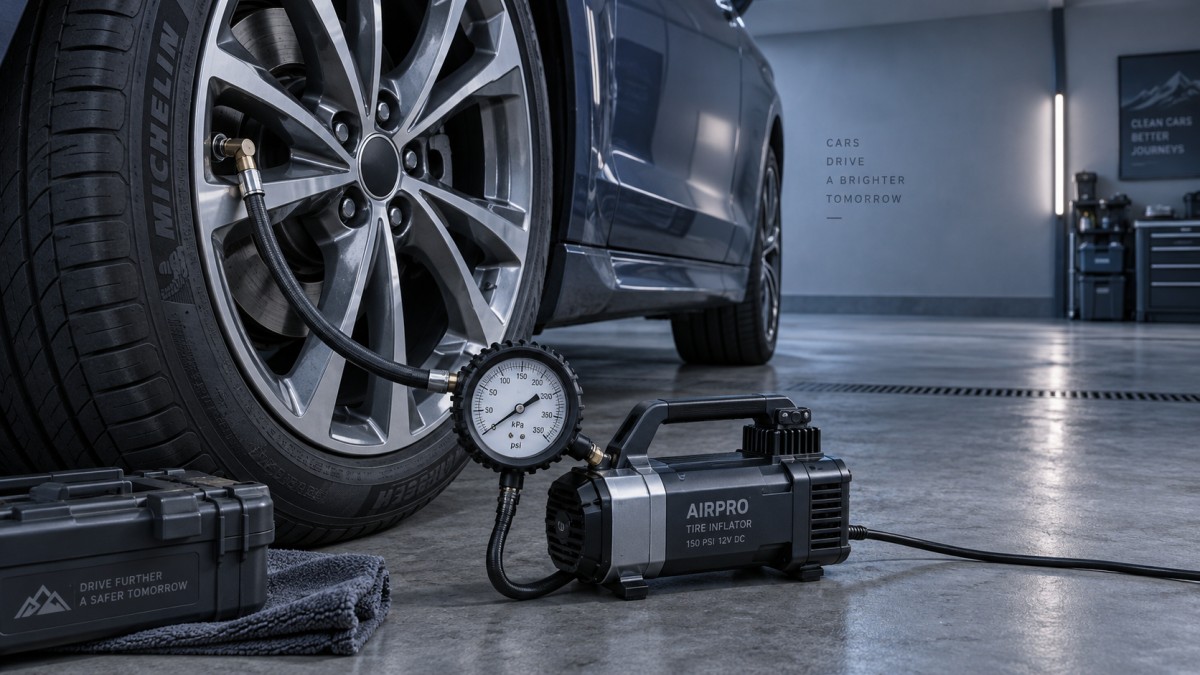
A consistent measuring technique matters when comparing results. Repeatedly attaching a gauge releases a little air, while a tilted connector can cause a larger leak. If two instruments disagree repeatedly, confirm the pressure with a gauge of known accuracy rather than averaging their readings.
Equipment specifications also need context. The All-in-One Jump Starter and Tire Inflator APS-542 lists a pressure range of 3–150 psi and selectable PSI, BAR, KPA, and Kg/cm² units. Its upper pressure limit describes equipment capability, not the target for a car tire. Its listed 33 L/min airflow and 5.5-minute inflation time do not establish how long every adjustment will take; tire volume, starting pressure, and operating conditions affect the task.
If the tires are already warm
Do not bleed air from a warm tire simply because its reading exceeds the placard’s cold pressure. Pressure normally rises during driving. Reducing that warm reading to the cold specification can leave the tire underinflated after it cools.
There is no reliable universal amount to subtract from a hot reading. Highway driving, heavy loads, sunlight, and ambient temperature changes produce different temperature increases. A fixed correction applied without vehicle-specific guidance can hide an inflation problem or create one.
If a warm tire reads below the specified cold pressure, treat it as underinflated. Where the tire appears sound and the vehicle’s instructions permit continued use, add air according to those instructions and arrange a cold recheck at the next suitable opportunity. Do not postpone attention solely because the ideal measuring time has passed. A visibly flat tire, rapid loss, or evidence of damage calls for stopping and assessment before further travel.
After a roadside top-up, recheck once the vehicle has rested for at least three hours under suitable conditions. The warm adjustment is an interim action; the rested measurement establishes whether the final pressure matches the vehicle specification.
Separate temperature changes from recurring air loss
A drop across all tires following colder weather is consistent with a temperature change. One tire falling noticeably below the others under comparable conditions points toward a localized problem, such as a puncture, leaking valve, or leak at the tire-to-wheel sealing surface. Compare readings taken cold with the same gauge before drawing that distinction.
Repeatedly topping up the same tire leaves the underlying cause unresolved. Note which wheel loses pressure and how quickly the reading changes, then arrange inspection. A tire that has been driven severely underinflated can have internal damage even after it holds air again.
The tire pressure monitoring system supports this routine, but its warning threshold is not a precise inflation target. Some systems require driving or a reset before the display updates. Verify the actual cold pressure with a gauge and follow the manual’s reset procedure where required; an extinguished warning alone does not confirm that every tire matches its specified setting.
Please give us a message