
News
- ▶ Are Jump Starters & Battery Boosters Becoming a Standard Car Essential?
- ▶ Jump Starters & Battery Boosters Demand Outlook for the Next Sales Cycle
- ▶ What Recent Battery Failures Reveal About Jump Starters & Battery Boosters
- ▶ Jump Starters & Battery Boosters: New Standards Changing Product Reviews
- ▶ 2026 Price Pressure in Jump Starters & Battery Boosters Supply
Message
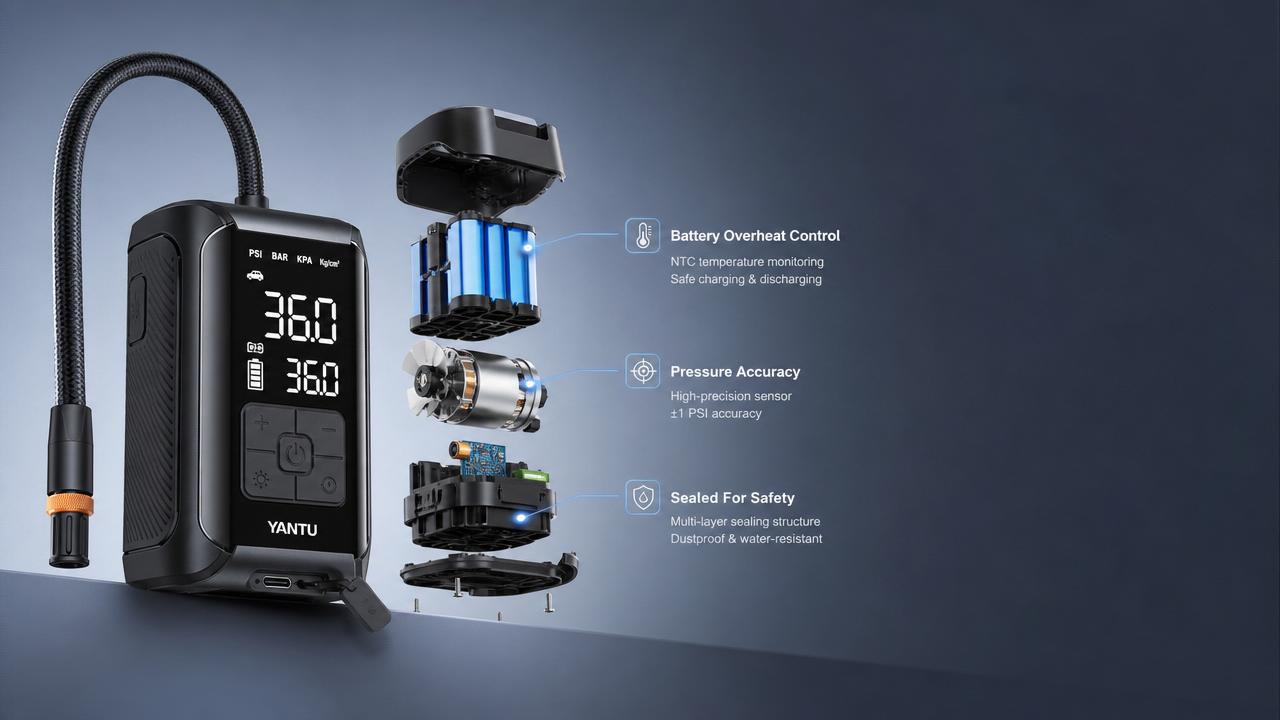
For quality control and safety managers, the main concern in an All-in-One Portable Tire Inflator is not whether the product can inflate a tire in ideal conditions. The real question is whether the design remains safe, accurate, and controllable across charging, storage, transport, repeated use, and misuse.
In practice, most serious product risks come from a limited group of design weaknesses. These include lithium battery overheating, unstable pressure sensing, poor sealing, motor overload, charging circuit faults, and inadequate protective logic. If these issues are not identified early, they can lead to field failures, compliance problems, warranty claims, or even user injury.
For QC teams and safety managers, a useful review framework should go beyond component inspection. It should examine how the battery, pump, sensor, PCB, enclosure, hose, and firmware interact as one system. Good design control reduces recall exposure, improves consistency, and strengthens trust in the final product.
What Safety and Quality Teams Should Evaluate First
When reviewing an All-in-One Portable Tire Inflator design, the first priority should be system-level failure modes rather than isolated parts. A product may pass basic functional tests while still carrying hidden risks under temperature stress, vibration, overcharging, blockage, or prolonged continuous operation.
The most important questions are straightforward. Can the unit control heat during charging and inflation? Does it stop accurately at the target pressure? Will seals, valves, and hoses remain reliable after repeated cycles? Can the electronics detect abnormal conditions before they become hazardous?
These questions matter because portable inflators combine several risk sources in a compact enclosure. A rechargeable battery, high-current motor, pressure chamber, heat-generating electronics, and user-facing controls all operate close together. That design density increases the chance that one weakness will trigger another.
Battery Overheating Is Often the Most Critical Design Hazard
Among all common safety risks, battery-related failure usually deserves the earliest and deepest review. Most all-in-one units rely on lithium cells, and these cells introduce thermal, electrical, and transport safety concerns that can escalate quickly if the design margins are weak.
Overheating may begin with cell quality, but it is often amplified by product design. Insufficient spacing, poor heat dissipation, weak charging control, undersized wires, or long high-load pumping cycles can push battery temperature beyond safe limits. In compact devices, trapped heat becomes a major hazard multiplier.
QC and safety teams should check whether the design includes overcharge protection, over-discharge protection, overcurrent cutoff, short-circuit protection, and temperature monitoring. It is not enough for these features to exist on paper. They must be validated under real operating stress, including elevated ambient temperatures.
Another common weakness is mismatch between advertised performance and battery capability. If the product promises fast inflation, high pressure, lighting, digital display, and USB output in one unit, the energy system may be pushed close to its limit. That can create thermal instability and shorten service life.
Battery pack fixation also matters. If cells are poorly secured, transport vibration or impact can damage internal connections. Repeated movement can cause insulation wear, connector loosening, or weld fatigue. These issues may not appear in short bench tests but can emerge later in customer use.
Pressure Misreading Can Turn a Useful Device Into a Safety Liability
For end users, inflation accuracy is one of the most visible quality measures. For safety managers, it is also a major risk point. A portable inflator that overreads or underreads pressure may cause underinflation, overinflation, tire performance issues, or customer distrust.
Pressure errors often come from more than sensor quality alone. They may result from poor sensor calibration, thermal drift, air path leakage, unstable firmware filtering, vibration, or delays between actual chamber pressure and displayed pressure. In integrated products, measurement reliability depends on the full system.
One recurring design mistake is placing the sensor in a location heavily affected by heat from the motor or PCB. As internal temperature rises, the sensor output may drift. If compensation logic is weak, the displayed pressure becomes increasingly inaccurate during longer inflation cycles.
Another issue is how auto-stop functions are tuned. If the cut-off threshold, sampling rate, or software correction is not validated well, the inflator may stop too late or too early. This is especially problematic for users relying on preset pressure values for cars, bikes, or sports equipment.
QC teams should require repeatability testing across different temperatures, charge levels, and inflation loads. It is also wise to compare readings against calibrated reference equipment under multiple use scenarios, not only at a single pressure point in laboratory conditions.
Poor Sealing and Air Leakage Reduce Safety Margins and Product Credibility
Air leakage is sometimes treated as a performance defect rather than a safety concern. In reality, poor sealing can create several risk chains. It can extend motor run time, increase battery load, raise internal temperature, reduce pressure accuracy, and lead users to repeat operation unnecessarily.
Typical leakage points include hose connections, valve interfaces, pump chamber seals, threaded joints, and aging rubber parts. In an all-in-one design, repeated bending or storage of the hose can add mechanical stress, especially where rigid and flexible parts meet.
Material selection is a frequent source of long-term sealing problems. If elastomers are not matched to expected temperature ranges or pressure cycles, compression set and hardening may appear early. A unit may pass outgoing inspection yet develop leakage after storage, seasonal heat exposure, or repeated use.
Seal design should also consider user behavior. Over-tightening, angled attachment, dust contamination, and rushed disconnect actions are common in real use. Products with narrow assembly tolerance but poor misuse tolerance often perform well internally and poorly in the field.
For quality evaluation, accelerated aging, pressure retention tests, drop tests, and repeated connection-cycle tests provide more meaningful data than a one-time leak check. Teams should focus on leak growth over time, not only initial pass or fail status.
Motor Overload and Thermal Buildup Are Common in Compact Inflator Designs
The air pump motor is the core power component, and it is also one of the main heat sources. If design expectations exceed motor capability, the product may suffer from overheating, insulation degradation, reduced pressure output, or early failure in customer hands.
Overload often occurs when compact inflators are marketed for broad use cases without sufficient duty-cycle control. Inflating a bicycle tire, topping up a car tire, and handling a larger SUV tire do not impose the same load. If usage boundaries are unclear, users may unintentionally operate the unit beyond safe limits.
Some products also fail to manage blocked airflow or high back pressure well. When the hose is kinked or the target pressure approaches the pump limit, current draw and internal heat can rise sharply. Without proper thermal cutoff logic, this condition can damage the motor or nearby components.
Cooling path design deserves close attention. Enclosure aesthetics often reduce vent area or restrict airflow. If battery, motor, and control board are packed too tightly, localized hot spots can develop even when average exterior temperature appears acceptable. Internal mapping is therefore more informative than surface checks alone.
Safety managers should ask whether the design includes clear duty-cycle limits, thermal shutdown thresholds, restart logic, and user warnings. These controls reduce the chance that a normal-use device becomes unsafe simply because users expect more runtime than it can safely deliver.
Charging Circuit and Power Management Failures Can Trigger High-Risk Events
Because many models are rechargeable, charging safety is as important as inflation safety. Faults in the charging path can produce overvoltage, unstable current, connector heating, or battery stress. In severe cases, they increase the probability of swelling, smoke, or thermal runaway.
USB-C and similar interfaces improve convenience, but they also introduce compatibility variables. Different adapters, poor-quality cables, and inconsistent negotiation behavior can expose weak designs. A robust product should tolerate common charging conditions without entering unsafe thermal or electrical states.
PCB layout quality matters here. Narrow traces, inadequate spacing, poor grounding, or weak protection component selection can reduce safety margins. Soldering quality also affects reliability. Cold joints or marginal connector attachment may pass production tests yet fail after vibration or repeated plug-in cycles.
Another overlooked issue is simultaneous charging and high-load operation. If the product supports pass-through use, the thermal and power-management strategy must be carefully validated. Charging a battery while running a motor inside a compact enclosure creates a demanding condition that can expose weak design assumptions.
For this reason, safety review should include abnormal charging tests, connector insertion-cycle testing, and temperature rise analysis around ports, ICs, and battery contacts. The goal is to identify hidden stress concentration before mass shipment begins.
Control Logic, Firmware, and User Interface Can Also Create Safety Risks
Not all safety failures are mechanical or electrical. Firmware and interface design can also produce hazardous outcomes. If the display, auto-stop logic, mode selection, or low-battery warning is confusing or unreliable, users may make decisions based on incorrect information.
For example, a preset mode that defaults to the wrong unit or pressure range can result in overinflation. A delayed display refresh can make users think the product is unresponsive, leading them to disconnect and reconnect under pressure. A weak low-battery strategy may cause abrupt shutdown during use.
Safety teams should assess whether alarms are visible in bright outdoor conditions, whether controls are intuitive under stress, and whether misuse scenarios are anticipated. A product that is technically compliant but operationally confusing may still produce high complaint rates and unsafe user behavior.
Firmware validation should include fault injection where possible. Sensor disconnection, voltage drop, button bounce, communication errors, and thermal alarm triggers should all be tested. A safe product must fail in a controlled way rather than continue operating with unreliable internal data.
Mechanical Strength, Drop Resistance, and Transport Safety Should Not Be Treated as Secondary
Portable products are routinely dropped, squeezed into toolboxes, left in vehicles, and exposed to vibration during shipping. Mechanical design therefore has direct safety implications. Cracked housings, damaged mounts, or displaced internal components can create electrical or thermal hazards later.
In an All-in-One Portable Tire Inflator, battery pack retention, PCB support, hose storage structure, and switch protection are all important. A drop that seems cosmetic from the outside may loosen a connector, deform a seal, or damage insulation between high-current parts and the enclosure.
Transport safety becomes even more important for cross-border distribution. Products containing lithium batteries must maintain mechanical integrity throughout packaging, warehousing, and delivery. A design with weak internal fixation can show low failure rates in factory tests yet perform poorly after logistics handling.
QC personnel should combine drop testing with post-test functional, leakage, charging, and thermal checks. This helps determine whether the product merely survives impact cosmetically or remains genuinely safe and reliable afterward.
How QC and Safety Managers Can Build a More Practical Review Checklist
To make evaluations more effective, teams should organize review points by failure consequence, not by department alone. In other words, examine what could cause overheating, inaccurate inflation, leakage, electrical fault, or unsafe user action, and then trace each risk back to design controls.
A practical checklist for an All-in-One Portable Tire Inflator should cover battery protection, sensor accuracy, air sealing, motor duty cycle, PCB robustness, charging safety, firmware fail-safe behavior, enclosure strength, and labeling clarity. This approach is more useful than relying on appearance and basic function only.
It is also important to verify consistency between engineering samples and mass-production units. Some safety risks appear only when materials change, assembly tolerance shifts, or suppliers vary. Process control, incoming inspection, and final validation should therefore be aligned with the original design risk analysis.
Manufacturers with integrated R&D, mold design, and production capabilities usually have an advantage here. When design, tooling, testing, and assembly are coordinated internally, it is easier to identify root causes quickly, implement corrective action, and maintain traceability across product revisions.
Why Early Design Risk Control Brings Business Value, Not Just Compliance
For many companies, safety review is still seen mainly as a compliance task. But for products like portable inflators, early design risk control delivers broader value. It reduces returns, protects brand reputation, stabilizes field performance, and lowers the total cost of quality.
For importers, private-label brands, and sourcing teams, a safer and more reliable design also improves long-term commercial confidence. Fewer complaints, better review scores, and lower after-sales burden all support stronger channel relationships. In competitive categories, reliability often becomes a deciding factor.
This is why experienced manufacturing partners matter. A supplier with mature production systems, controlled in-house processes, and customization capability can often identify practical risk points before they become market issues. That is especially valuable when buyers need both product differentiation and dependable safety performance.
Conclusion
The common safety risks in All-in-One Portable Tire Inflator design are usually concentrated in a few critical areas: battery thermal control, pressure accuracy, sealing integrity, motor overload, charging protection, control logic, and mechanical durability. These are the issues that most directly affect user safety and product reliability.
For QC personnel and safety managers, the best approach is to review the inflator as an integrated system, not a collection of separate parts. When risk assessment, validation testing, and production control are aligned early, it becomes much easier to prevent incidents, reduce recall exposure, and support consistent market performance.
In short, a well-designed portable inflator is not defined only by inflation speed or feature count. It is defined by how safely and predictably it performs under real-world conditions. That is the standard quality and safety teams should use when making design decisions or supplier evaluations.
Please give us a message