
News
- ▶ Are Jump Starters & Battery Boosters Becoming a Standard Car Essential?
- ▶ Jump Starters & Battery Boosters Demand Outlook for the Next Sales Cycle
- ▶ What Recent Battery Failures Reveal About Jump Starters & Battery Boosters
- ▶ Jump Starters & Battery Boosters: New Standards Changing Product Reviews
- ▶ 2026 Price Pressure in Jump Starters & Battery Boosters Supply
Message
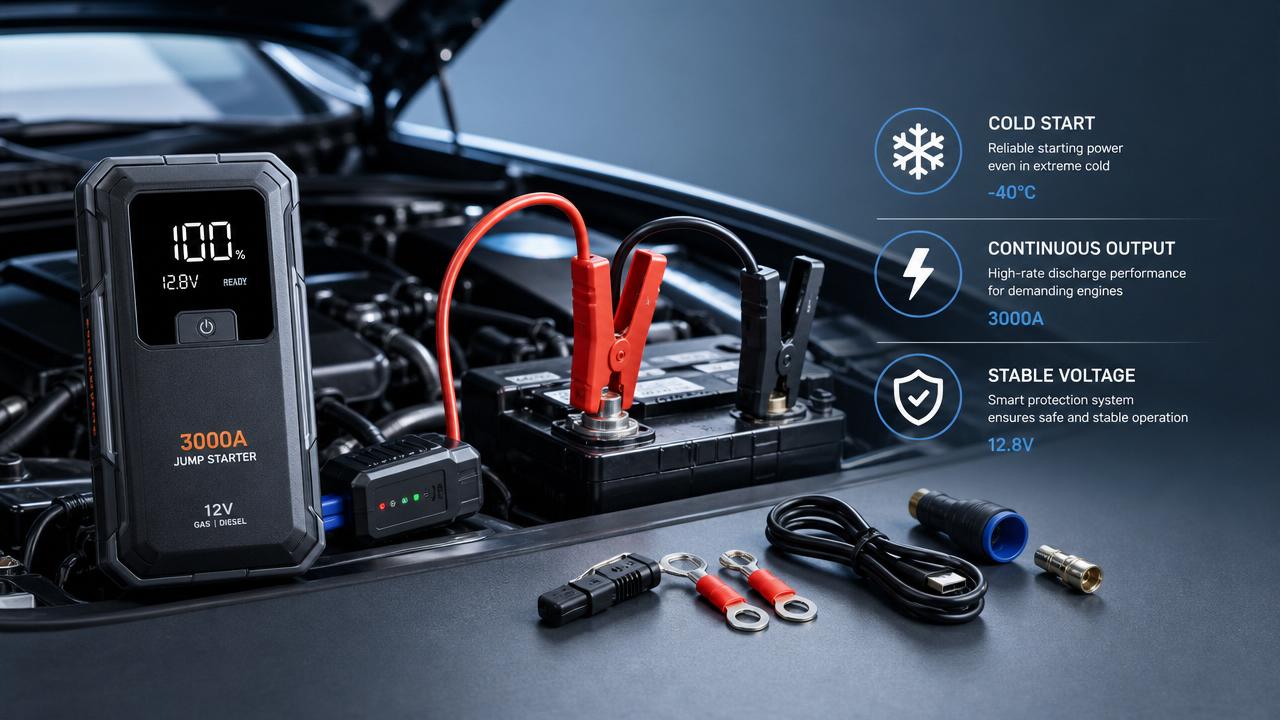
When comparing Jump Starters & Battery Boosters, technical evaluators should look beyond peak amps and focus on the performance claims that directly affect reliability, safety, and real-world starting power.
From battery chemistry and cold-start capability to protection systems and production consistency, understanding which specifications truly matter helps identify products that deliver stable performance and long-term value.
What Technical Evaluators Are Really Looking For
The core search intent behind Jump Starters & Battery Boosters is not basic product education. Technical evaluators usually want to know which claims predict dependable field performance.
They are comparing specifications, filtering out inflated marketing language, and building a practical checklist for sourcing, qualification, or product-line selection.
In most cases, the biggest concern is simple: which measurable claims actually indicate that a jump starter will start vehicles reliably, safely, and repeatedly in real conditions.
That means peak current alone is rarely enough. A product can advertise a high number yet still underperform in low temperatures, repeated starts, or aging tests.
For this audience, the most useful content is decision-oriented. They need clarity on battery type, sustained discharge ability, cold-start performance, safety controls, manufacturing consistency, and verification methods.
General lifestyle benefits, consumer-oriented convenience features, and vague claims about portability matter less unless they influence operational reliability or qualification risk.
Why Peak Amps Are Often the Most Misleading Claim
Among all advertised metrics for Jump Starters & Battery Boosters, peak amps are the most visible and often the least useful when viewed in isolation.
Peak current may represent a very short discharge event under controlled conditions. It does not always reflect the unit’s ability to deliver enough cranking power over a realistic starting window.
Technical evaluators should ask whether the supplier also provides cranking amps, starting current duration, and test conditions. Without those details, the headline number has limited engineering value.
A jump starter that claims 3000 peak amps may still fail to support a hard-starting engine if voltage collapses too quickly under load.
What matters more is how current delivery is sustained, how the internal battery behaves under high discharge, and whether output remains stable across temperature ranges.
If the specification sheet highlights only peak amps and avoids waveform, load duration, or recovery data, that is a signal to probe deeper.
Cold-Start Capability Matters More Than Room-Temperature Performance
For vehicle starting products, low-temperature performance is one of the most practical indicators of real-world value. Batteries, cables, electronics, and clamps all behave differently in the cold.
Many Jump Starters & Battery Boosters perform adequately in a warm lab but lose effectiveness when exposed to winter field conditions.
Evaluators should look for claimed operating temperature ranges, low-temperature discharge behavior, and evidence of successful cold-engine starting tests.
Ideally, testing should define engine type, battery condition, ambient temperature, and start success rate. A broad claim like “works in winter” is not enough.
Lithium-based systems, in particular, can show significant output variation depending on cell chemistry and battery management strategy.
If the target market includes roadside service, fleet support, emergency kits, or export regions with harsh climates, cold-start verification should be treated as a primary qualification criterion.
Battery Chemistry Directly Affects Output, Lifespan, and Safety
The battery chemistry inside a booster strongly shapes its performance profile. It affects discharge capability, shelf life, cycle life, recharge speed, temperature tolerance, and protection design.
Most modern compact products use lithium batteries, but not all lithium chemistries behave the same way. Cell selection influences consistency under high load and long-term durability.
For technical evaluation, it is important to understand whether the product uses cells optimized for power discharge or merely for energy density.
Lead-acid designs may still appear in some heavy-duty contexts, but they are larger, heavier, and generally less attractive for portable smart devices.
When reviewing Jump Starters & Battery Boosters, ask about cell grade, cycle retention, storage degradation, balancing logic, and battery management protections.
A strong product is not defined only by initial starting power. It should retain usable output after storage, transport stress, repeated cycles, and seasonal temperature changes.
Cranking Duration and Voltage Stability Reveal Real Starting Power
A vehicle engine does not care about marketing numbers. It responds to whether sufficient current and voltage are maintained long enough to complete ignition.
This is why evaluators should pay close attention to discharge curve behavior and loaded voltage stability during cranking events.
Two units with similar current claims can perform very differently if one holds voltage better under surge demand. Stable output usually translates into more reliable starts.
Cranking duration is especially important for larger gasoline engines, older batteries, and diesel applications that require stronger and more sustained support.
Suppliers that can share test records for actual start attempts, repeated-use intervals, and load simulations provide more credible data than suppliers using isolated peak figures.
If possible, request evidence under multiple states of charge. A product that performs only when fully charged may create field reliability issues.
Protection Systems Are Not Optional Features
Safety functions in Jump Starters & Battery Boosters should be treated as core performance attributes, not accessory features.
Reverse polarity protection, short-circuit protection, overcurrent control, overcharge protection, thermal shutdown, and spark suppression all reduce operational risk.
For technical evaluators, the main question is not whether such features are listed, but how reliably they work under abnormal use conditions.
A protection circuit that reacts too slowly may fail to prevent damage. One that is too sensitive may interrupt legitimate starting attempts and reduce usability.
The design quality of clamps, cabling, MOSFET selection, PCB layout, and battery management integration all affect protection performance.
Products aimed at wide distribution, cross-border sales, or drop-shipping channels especially need robust protections because end-user behavior cannot be tightly controlled.
Cycle Life and Shelf Stability Matter in Procurement Decisions
Technical evaluators often focus first on start performance, but long-term economics depend heavily on degradation characteristics.
A jump starter may deliver acceptable output at launch yet lose too much capacity after storage or repeated use, creating warranty exposure and customer dissatisfaction.
Useful claims include cycle life at defined discharge depth, capacity retention after storage, self-discharge rate, and recovery after long idle periods.
This is especially relevant for emergency-use products, which may sit unused for months before a critical start attempt is needed.
For B2B buyers, shelf stability also affects channel performance. Distributors, installers, and cross-border fulfillment models need products that remain dependable through inventory turnover cycles.
If lifecycle data is absent, technical teams should request accelerated aging results or retention comparisons across batches.
Charging Speed Is Useful, but Recharge Quality Is More Important
Fast recharge is attractive, but technical evaluators should be careful not to overvalue charge time without understanding its impact on battery health and readiness.
A well-designed charging system balances recovery speed, thermal control, cell protection, and long-term battery preservation.
Questions worth asking include whether the charging algorithm includes balancing, overvoltage protection, temperature monitoring, and stable input compatibility.
In portable products, USB-C or similar modern input options can improve usability, but interface convenience should not distract from charge safety.
If a product recharges quickly but accelerates cell stress or creates uneven battery aging, the short-term benefit may produce long-term reliability loss.
Recharge quality is especially important when the same unit is expected to support both emergency starts and broader smart power functions.
Clamp, Cable, and Connector Design Can Make or Break Performance
Some of the most important performance losses in Jump Starters & Battery Boosters happen outside the battery pack itself.
Clamp material, spring force, copper content, insulation quality, cable gauge, and connector resistance all affect current transfer efficiency.
A high-quality internal battery can still deliver poor field results if voltage drop across the output path is excessive.
Technical evaluators should inspect whether clamps maintain strong contact under vibration, corrosion exposure, and repeated use.
Mechanical durability also matters. Weak hinges, brittle housings, or unstable cable joints often become the first points of failure in service.
For private-label or custom programs, these hardware details deserve as much scrutiny as the battery cells because they directly affect start success and complaint rates.
Verification Data Is More Valuable Than Specification Density
One common sourcing mistake is assuming that a longer specification sheet means a better product. In practice, verification quality matters more than the number of listed features.
Technical evaluators should prioritize suppliers that can explain test standards, lot consistency, inspection methods, and failure-control processes.
Useful evidence may include incoming material checks, in-process quality control, load testing, aging tests, finished-product inspection, and traceability records.
For Jump Starters & Battery Boosters, batch consistency is critical. A strong prototype means little if mass production output drifts over time.
This is where manufacturing integration becomes relevant. Suppliers with in-house R&D, mold development, and production control usually have better ability to stabilize quality and respond to custom requirements.
Qingdao Shinod Intelligent Technology Co., Ltd., for example, operates with an integrated production chain from development to mass production, helping control lead times, cost, and execution consistency.
Customization Should Not Undermine Reliability
Many buyers want differentiated housings, branding, cable configurations, packaging, or feature sets. Customization can be valuable, but it should not compromise validated performance.
Every design modification can influence thermal behavior, assembly complexity, structural strength, or electrical resistance.
Technical evaluators should confirm whether customized variants undergo the same validation process as standard models.
This includes checking that battery management logic, enclosure ventilation, connectors, and internal layout remain suitable after changes.
A manufacturer with internal mold design and production capability is often better positioned to execute custom projects without losing process control.
That matters when procurement teams need both differentiation and predictable field performance from Jump Starters & Battery Boosters.
A Practical Evaluation Checklist for Comparing Products
To make comparisons more objective, technical evaluators can use a weighted checklist focused on real operating value rather than headline marketing claims.
Start with battery chemistry, actual cranking behavior, low-temperature start capability, and loaded voltage stability. These define the product’s core function.
Then assess protection systems, cycle retention, shelf stability, recharge quality, and hardware design including clamps and cables.
After that, review production consistency, quality documentation, and the supplier’s ability to support customization without increasing reliability risk.
Finally, examine commercial practicality: lead time control, service responsiveness, and whether the manufacturer can sustain supply at scale.
A company with stable production capacity, standardized manufacturing, and flexible supply models can reduce sourcing friction beyond the product specification itself.
What Performance Claims Matter Most in the End
For technical evaluators, the most meaningful claims are the ones tied to repeatable starting success, safe operation, and stable quality over time.
That means cold-start capability, sustained cranking output, voltage stability, battery chemistry suitability, and verified protection systems should rank above inflated peak amp figures.
Long-term value also depends on cycle life, shelf stability, component durability, and production consistency. These factors often determine whether a product succeeds after launch.
When reviewing Jump Starters & Battery Boosters, it is best to treat marketing claims as starting points, not conclusions.
The right product is not simply the one with the biggest number on the box. It is the one that can prove reliable performance under realistic conditions and across repeat production.
That is the standard technical teams should use when identifying a manufacturing partner and selecting a booster that delivers both operational confidence and commercial value.
Please give us a message